Friday, November 9, 2012

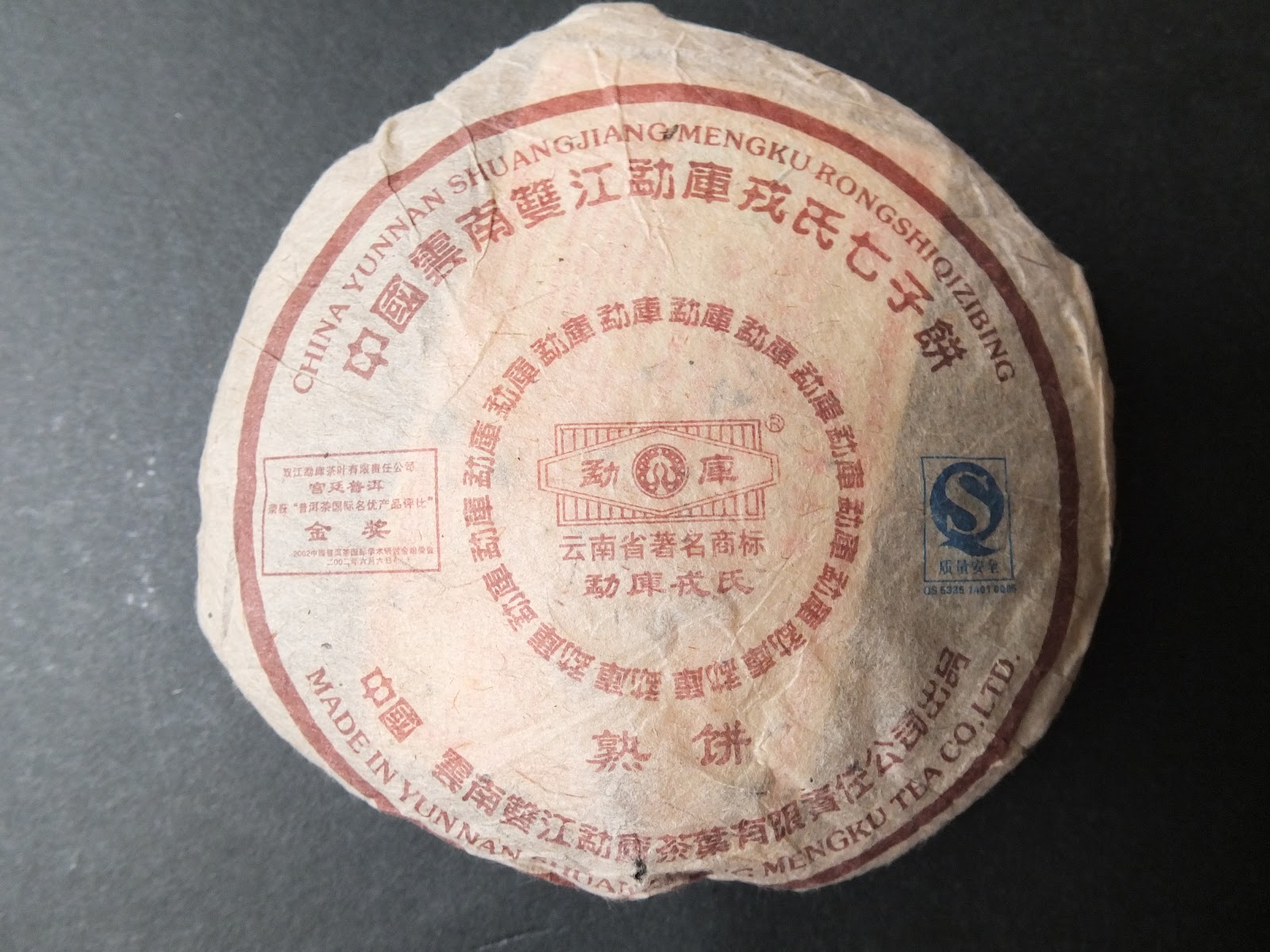
2006 Mengku Ripe 145g - a revisit


My first encounter with this mini cake was in my Oct 24 2009 blog.  

This is the 2006 Mengku 145g cake.  The wrapper indicated that this was a gold medal award winning cake at a tea competition.  Since I had purchased a few of these cakes and had quite good impressions of this tea, I did a revisit and opened up a cake.

It was a big surprise that when I broke off a chunk to brew; this tea tasted quite bland; nothing impressive.  It was a worrying moment.  Was my storage conditions not good for tea?  Were my expectations of this tea too lofty?  Maybe this was just a regular ripe cake?

I had brewed this tea by breaking off a 9g chunk and started my tea session.  This had deviated from my current practice of breaking up tea cakes/bricks and putting it in a tea caddy for a few days before I start drinking the tea.  I cannot give you a clear explanation on why the pu erh tea would taste much better if the tea chunks had a few days to 'breathe'.  I had consumed a good number of pu erh cakes for the past few years to arrive at this conclusion.  I find that the taste and aroma improvements are more pronounced in ripe/shu than raw pu erh.  Perhaps this is what tea masters call 'tou-chi', a chinese term to describe taking a breather.  Some tea experts have also mentioned about 'waking the tea' (aka xin-cha).......perhaps this is what I might be doing.  I even have a Malaysian friend, that had advised me, that he unwrapped his tea cake (for drinking), enclosing the cake in a biscuit or mooncake tin for a week before he break up the cake.  

Yes, what I have just said would have sounded like a 'believe it or not' urban legend.  I may be wrong.  I may be imagining or bluffing myself.    Anyway, let me know your thoughts. 

So, after a few days of storing my broken up chunks of this Mengku tea cake, my tea session of this pu erh became a very pleasant experience. The aroma and taste of this pu erh is strong and highly aromatic.  This tea would brew to a darker color but its not bitter and its very enjoyable - a very comforting sensation when I drink up every cup. 


Sunday, November 4, 2012

Peony Tea S.


Peony Tea S. is an online tea shop.  Owned and operated by Mr & Mrs Derek Chew, they specialize in selling loose tea from China and Taiwan.  Having started the business last year, Derek is slowly but surely adding a good range of teas for sale to tea drinkers around the world.

In his own words :

“It was over 10 years ago when a major paradigm shift was experienced, his parents had returned from Hangzhou and brought back none other than the fabulous Long Jing. Then, prices of Long Jing was not so ridiculous and inferior knock-offs did not flood the market like they do today hence even his parents who were casual tea drinkers could purchase decent quality Meijiawu Long Jing as tourists.
For Derek it was love at first sip- falling in love with the refreshing taste and sweet lingering finish he only knew later as ‘hui gan’. It changed his perspective on Chinese tea completely.
Still his fear of insomnia and packed weekend schedules- he was a teenager (and later a young adult) then after all- meant tea could only be a sporadic indulgence for him. It was only when Derek discovered the humble infuser mug that he was liberated to enjoy tea daily in the office.
Derek always believed that if more people had the opportunity to experience authentic Chinese tea, brewed right without the intimidation and mystique that could frighten novices off, it could gain a mass following instead of being a somewhat niche interest.”

Derek had included his take on brewing a Danchong as follows:

“Fill the gaiwan with 1/3 to ½ full of leaves (depending on the ‘density’ of the leaves)
Rinse with hot water
Add hot water (85°C or 185°F)
Infuse for 30 sec (for the first steeping) – or until my nose tells me it’s okay- and pour out
Increase about 10-15 sec for each infusion

The combination of the lower heat and steeping time allows a fuller release of the nuances of dancong without an excessive amount of bitterness.”

Derek has created a sample set of his tea for sale and included a discount code (WLTT1020 – valid till 23 Nov 2012) for readers if you decide buy tea from Peony Tea S.

I do not have any business interest in this company.  I wish Derek and his wife the very best in his tea business.

www.peonyts.com

Sunday, October 21, 2012

2006 Xiaguan Gold Ribbon Tuo 100g


I opened a 2006 Xiaguan 'gold ribbon' tuo today.  This 100g tuo comes packed in its own box and yes, a gold ribbon is enclosed inside as well.  Xiaguan started producing this tea in 2004 (see bottom pix- top tuo) and has been producing this tea yearly due to its popularity among chinese tea drinkers.  Its inexpensive with the current year tuo priced at less than $5.

Yunnan Sourcing promotes this tea as "The "Gold Ribbon" blend was first introduced in 2004, when it was a special order production for a large Guangzhou Xiaguan wholesaler.  Using superior material from Wu Liang, Yun Xian, and Yun Long mountains, and carefully blended to be full of aroma and cha qi.  This has now become a classic premium blend from Xiaguan!"

I noticed a nice delightful pronounced honey aroma when I brew a pot of this Xiaguan tuo.  I normally drink a cup of honey a couple of times a week (half mug cool water and stirring in a spoonful of honey).  The aroma from the tea is like drinking a nice cup of honey -  a sweet, fresh floral scent.  This tea is non smoky unlike the other Xiaguan tuos I had encountered, but I enjoy this tea very much.  A refreshing and happy tea.  I do recommend you include a tuo in your next tea purchase. 

One more thing, do not throw away the tuo box after use.  It makes a mini tea caddy and is especially good for pu erh as this paper box allows your pu erh to 'breathe' especially when you have broken up a pu cake/brick for drinking.

Bottom pix shows 3 Xiaguan gold ribbon tuos.  Top tuo - 2004, bottom left -2006, right -2009.

Sunday, October 14, 2012

2008 Tian Fu Yang Ripe Brick 500g


I had purchased this ripe pu erh brick on one of my visits to Qiu Xiang teashop in Kuala Lumpur, Malaysia last year.  This is a 2008 Tian Fu Yang brick.  I had sampled this pu erh at the tea shop and decided to buy this hefty 500g brick for slightly less than US$15.  

This ripe brick, as described on the wrapper, was made with tea leaves from the Bulang region in Yunnan.     I would brew 8-9g of this tea in my 190ml teapot and I prefer longer infusions for this pu erh tea.  It brewed up an aromatic scent with a mild sweet finish. The sweetness is nutty like eating freshly roasted chestnuts.  A brew of this tea can yield 8 good cups of tea. 

But I digress.  I had earlier mentioned in my earlier blogs that old ripe pu erh has a mellow taste and can   developed an aged taste as well.  One clear difference between drinking a ripe tea than compared to drinking a raw pu erh tea is the overall sensations when you finish your tea sessions of that respective tea.  There are raw pu erh tea that may give the drinker a sensation of intoxication, or a 'happy high' that last a couple of minutes.  Some raw pu erh  may make a drinker sweat before a nice cooling releasing sensation sets in.  Ripe tea would not produce such results but to me, drinking a good ripe pu would give me a satisfying pleasant, mellow and earthy cup of tea whenever I brew a session of ripe tea.  Yes, there are many more differences, not pointed out by me,  that you the reader would have experienced.  I would encourage all pu drinkers not to stick strictly to drinking raw or ripe tea but to enjoy both types of pu erh tea, so that you can experience the full spectrum of taste, aroma, flavor and sensations of a pu erh tea.  

Saturday, October 6, 2012

Tetsubin Tea Kettle


My kid thought I had purchased an antique when I opened a box that arrived from Japan a few days ago.  Inside the box was a used Japanese Tetsubin tea kettle.  "I am going to use the kettle to boil water, and to brew tea with it' - I told my daughter when she had a closer look at the kettle.  Her reply was an exclamatory "whoa".

You, the reader will ask me, after looking at the pix,....why buy an old kettle? Its old and even has some discoloring marks on the inside of the kettle.  

Well, I was chatting with a new tea friend from Ipoh, Malaysia about pu erh in general when I was told to buy a tetsubin kettle.  I was told to get such a kettle as a tetsubin 'sustains heat better from fire to pot so there is little reduction in heat from kettle to pot......and for vintage tea you need really hot water to bring the tea out'.  I laugh in jest.   It could be a psychological enhancement......its all in the mind.  Another user had also  told me the water tasted better.  Curiously, in the back of my mind, I could vaguely recollect that I had seen such kettles in use......at a friend's place in Hong Kong, a tea shop in Kuala Lumpur, Malaysia and in another tea shop in Taipei, Taiwan.  Water in Singapore can be drunk straight from the tap.  The water here, comes from reservoirs, desalination as well as from a reverse osmosis process (from waste water).  I thought if a Tetsubin kettle can make my tea better.....its worth a try.  I decided to take up the challenge.

A tetsubin kettle is simply a cast iron kettle.  Its made from iron.  Nothing fancy.  Yes, I am sure you have seen iron cast pans and trays used in the kitchen but the popularity of using cast iron kitchenware is waning, at least in my part of the world.  The reason  - it rusts easily if the iron cookware are not taken care of properly.  You can imagine the tetsubin kettle is even less popular in our rush-rush urban cities.

At this point I would like to highlight the difference between a tetsubin kettle and a tetsubin teapot. The teapot is smaller from 300ml to about 1 litre while the kettle starts from about 500ml to more than 3 litres.  The tetsubin teapot is internally lined or coated.  It may be ceramic coated or a layer of 'teflon like" material is applied to the inside of the teapot so that rust would not occur in the teapot.  You would brew tea in that teapot.  A kettle on the other hand has no coating inside, and the kettle is only used to boil water.  Yes, one would place the kettle over a fire and boil the water.  This, as I gleaned from the internet, is where the water, coming into contact with the iron surface, would make brewing tea with this water a more tasty experience.  Further information from the internet said that I should not use any detergent in cleaning the kettle and I should keep the kettle dry when not in use.

There are many websites on the internet selling tetsubin kettles.  I decided to buy a used Japanese model.  I turned to ebay.  I snagged one 2 weeks ago. You would have observed that the surface of the kettle was dotty.  The seller mentioned that these bumps are called Arare design (aka hobnail).  The seller also mentioned that there are 'nambu tekkie' manufacture marks which signifies the popular Japanese foundries in the late 60s.  This kettle holds 500ml of water. It also comes with a matching trivet - where the hot kettle can sit without damaging the table top. 

This tetsubin is strangely captivating.  I realized that this kettle was a little small for my needs as I usually use more than a litre of water in one tea brewing session.  So......I got myself another larger Japanese one today.  "Whoa !".  Stay tuned.


Saturday, September 22, 2012

2003 Haiwan Lao Tong Zhi raw pu erh


This is a 2003 Haiwan Lao Tong Zhi raw pu erh cake.  I had purchased a few of these cakes locally and had kept them for 4 years in my study.  I opened one of these cakes for 2 reasons; to check the condition of the cakes and to find out how a brew of this pu erh cake would taste like.

One observation from the pictures seem to me that the cake had turn sightly brownish.  Compression of the cake is not as tight as new cakes.  Many tea dealers and tea friends had also told me that older cakes tend to lose their tight compression over time and a tea drinker may pry off a chunk of tea by hand especially for the older stored teas.  And....was also told to use less leaves as older teas tend to brew on the stronger side.

This cake came out 'fruity'.  This positive designation of 'fruity' as a description of raw pu erh tea refers to the subtle taste and aroma of fresh fruits.  No its not the stronger scented fruits of mangos or pineapples.  It rather like putting your nose in an apple where if you sniff deeply, and there is a light fresh fruity scent in the fruit.  This smell is more pronounced in an organic apple than a non organic one (so is the sweetness actually).  Perhaps many of the pu erh tea drinkers now prefer to buy and drink from gushu, or old tree pu, than plantation pu (aka tai de pu).  Many new pu erh tea are now being marketed as gushu or old tree pu, and it takes experience and time in drinking to distinguish a genuine gushu pu erh.

Back to this tea.  As said, the 'fruity' element in the tea is subtle.  Is this a gushu?  I am not sure.  I found that this tea is mellow and calming, with a very light sweet finish.  Non smoky.  It did not 'wow' me.  Maybe I had recently came across some older raw pu erh teas that had a camphor and a stronger and robust taste and aroma that I currently enjoy. 

Older pu erh tea has a very wide spectrum of taste, aroma, feel and aftertaste.  I look forward in enjoying this wide array of taste and aroma every time when I drink a cup of older pu erh tea.  I consider myself lucky I have in my collection a few of these cakes, that possess this nice 'fruity' characteristic.  


Saturday, September 15, 2012

Tea News - Hong Kong


From Agence France Presse 30 Aug 2012, this well written article is written by Beh Lih Yi.  Titled "Work, mahjong and tea : Hong Kong's secret to longevity".  

HONG KONG - Covered in smog and cramped apartment towers, Hong Kong is not usually associated with a healthy lifestyle. But new figures show that Hong Kongers are the longest-living people in the world.
Hong Kong men have held the title for more than a decade and recent data show women in the southern Chinese city overtaking their Japanese counterparts for the first time, according to the governments in Tokyo and Hong Kong.

Hong Kong women's life expectancy rose from an average 86 years in 2010 to 86.7 years in 2011, while Japanese women's longevity was hit by last year's earthquake and tsunami, falling to 85.9 years, census 
figures reveal.

So what is Hong Kong's secret to a long life?
Experts say there is no single elixir, but contributing factors include easy access to modern health care, keeping busy, traditional Cantonese cuisine and even the centuries-old Chinese tile game of mahjong.

Rolling stones gather no moss
"I love traveling, I like to see new things and I meet my friends for 'yum cha' every day," Mak Yin, an 80-year-old grandmother of six says as she practices the slow-motion martial art of tai chi in a park on a Sunday morning.

"Yum cha" is the Cantonese term to describe the tradition of drinking tea with bite-sized delicacies known as dim sum. The tea is free and served non-stop, delivering a healthy dose of antioxidants with the meal.
"My friends are in their 60s—they think I'm around their age too, although I'm much older than them," Mak laughs.

Mak's favorite food is steamed vegetables, rice and fruit. Cantonese food is famous for steamed fish and vegetables—dishes that use little or none of the cooking oils blamed for heart disease, obesity and high cholesterol.  But before Mak enjoys her afternoon tea, she  joins a group of elderly people for her morning exercise of tai chi, an ancient Chinese practice said to have benefits including improving balance and boosting cardiovascular strength.

A study published in the New England Journal of Medicine in February found that tai chi reduces falls and "appears to reduce balance impairments" in people with mild-to-moderate Parkinson's disease.

Another factor behind Hong Kongers' longevity, experts say, is work. While others long for the day they can retire and kick up their heels, many people in Hong Kong work well into their 70s and even 80s.
Hong Kong does not have a statutory retirement age and it is common to see elderly people working in shops, markets and restaurants alongside younger staff.
"Many old people in our city remain working, that contributes to better psychological and mental health," Hong Kong Association of Gerontology president Edward Leung says.
"For older people, a lot of them are stressed because they have nothing to do and they develop 'emptiness syndrome'. This causes mental stress."
Fishmonger Lee Woo-hing, 67, says he could not bear to sit at home and do nothing. His inspiration is local tycoon Li Ka-shing, Asia's richest man, who still runs his vast business empire in his 80s.
"If Li Ka-shing continues working at the age of 84, why should I retire?" asks the father-of-four during a break from his 14-hour shift at a bustling market in central Hong Kong.
"If I just sit at home and stare at the walls, I'm worried that my brain will degenerate faster. I'm happy to chat with different people here in the market."

'Mahjong delays dementia'
Hong Kong's cramped living conditions are famously unhealthy, fueling outbreaks of disease and viruses including bird flu and severe acute respiratory syndrome (SARS) which have killed dozens of people.
The city's reputation won it the dubious distinction of a starring role in director Steven Soderbergh's 2011 disaster thriller "Contagion", about a deadly virus that spreads from Hong Kong to the United States.
But in the day-to-day habits of ordinary people, experts say Hong Kong is a great place to grow old.
A popular local way of keeping busy and meeting friends is mahjong—a mentally stimulating tile game which can help delay dementia, according to aging expert Alfred Chan, of Hong Kong's Lingnan University.
"It stimulates the parts that control memory and cognitive abilities. It helps old people with their retention of memory," he says.

The complex rules and calculation of scores make mahjong, also known as the Chinese version of dominoes, mentally demanding. But the social aspects of the four-player game are just as important.
"In mahjong you need to play with three other people. It is a very good social activity, you have to interact with each other constantly," says Chan, who has studied the game's effects on the well being of elderly people.
"It is also a self-fulfilling game because if you win—whether you play with money or not—it gives you a sense of empowerment."

Mahjong parlors are popular in Hong Kong, and mahjong tables are a must at Chinese wedding banquets.

"I'm in semi-retirement. I work in the morning and hang out with my friends by playing mahjong in the afternoon," says 67-year-old tailor Yeung Fook, on the sidelines of a game in his modest garment shop.
"I'm happier when I work. It's boring to just sit at home."