Monday, September 6, 2021

2004 Nan Qiao Tea Factory Raw Pu erh Cake


I chose a 2004 Nan Qiao raw pu er cake to refill my tea caddy last week.  Readers would now I have a few tea caddies specially dedicated for pu erh tea.  I have 3 caddies for raw and 2 caddies for Shou or ripe pu erh.  I believed that breaking up a cake, brick or tuo and storing the tea in tea caddies do bring out the taste and aroma of the tea. This time, 3 caddies need to be refilled and I am happy choosing the teas to put in them. 

This 2004 Nan Qiao cake is very strong in my opinion. This is not a tea to introduce to a new Chinese tea drinker.  This tea is strong with woody and herbal notes.  There is a nice woody taste with an oak-like wood aroma (like those oak cask notes in a Scotland single malt whisky).  There is a bitterness of herbs.  I had sat down for about 30-45 min to have a tea session of this tea and there was a mild sweatiness and intoxicating sensation which lasted a few minutes.  There is hardly any sweetness but the oily sensation in the tea was very good. Mouthwatering and the tea simply slides down the throat.  There are some seasoned tea drinkers that prefer a more floral and sweeter profile....so such tea like this Nan Qiao may not appeal to all pu erh tea drinkers. 

If you like being 'tea drunk' or 'in a state of stupor" from drinking tea... such tea would be a good choice.  


Monday, August 16, 2021

Kettles For Brewing Chinese Tea


No, I do not collect tea kettles. But I own about 8 tea kettles. Why talk or write about tea kettles?  Aren't these kettles used for boiling water?

Yes, kettles are used for boiling water.  People in some parts of the world boil water for baths.  Where there is no water heater in the house, pouring a kettle or two of boiling water into a pail or tub would make bathing a warmer experience.  People in many countries boil water to sterilise the water for drinking.  Today in modern urban cities, we boil water in kettles to make hot drinks.  There are also now hot water 'on tap' where electric appliances or water dispensers can fill your mug with hot water without any waiting time.

When it comes to brewing Chinese tea, many tea drinkers and teashops would use a kettle in the tea sessions.  Having a Chinese tea session, whether by yourself or with a group of friends, is a more deliberate affair.  Tea is brewed and drunk more slowly than just 'gulp and go'. Chinese tea is unique in that a serving of tea (in this sense like 7g of oolong or pu erh) can make several infusions.  There are differences in each infusions (ever so slightly).  Each cup of tea taste different in terms of taste and aroma.  This uniqueness is further seen, when you revisit or have another session or the same tea.  The tea would have aged and taste even slightly different.

Using a right kettle or tea ware can make a tea session better.  That's what I did, I own kettles and tea ware that would make the Chinese tea I am brewing better in taste and aroma....again ever so slightly. Many tea users who used a Japanese tetsubin (cast iron) claimed the water is more smooth and 'softer' in the mouth.  There are also Chinese tea enthusiasts that believed clay kettles made the tea more vivid, amplifying the taste and aroma of the tea. There is a teashop in Malaysia that use the Hario kettle.  This stainless steel kettle was designed for drip coffee where one can control the pour of the hot water.  I enjoy using the Hario kettle as the pouring looks and felt more deliberate.

Pix shows 3 kettles.  The clay kettle is a vintage. The cover rest loosely on the rim and will rattle when the water is boiling. It is like a whistling kettle. The Japanese tetsubin has an unusual 'brown soil' colour on the exterior. It holds slightly over a litre of water; suitable for 1-2 person tea session.  The stainless steel kettle is the Hario 'drip kettle'.  It is great fun to use. 

I would try to have one tea session a day.  It gives me a mini 'get away' session from the hustle and bustle of city living. A time to contemplate or dream or just rest for a few moments from daily work.  I am happy sipping the tea for a few blissful minutes.  

Monday, August 2, 2021

An Inexpensive Tea


Good tea does not mean that the tea has to be expensive. 

If you had been reading my blog, you would had known that I sometimes bring some old Sea Dyke tea to tea meet ups and gatherings with friends. A few of my tea friends had claimed to had accumulated vast knowledge on oolong appreciation, and more often than not, will often look down on oolong brands like Sea Dyke. labelling them as cheap, inferior supermarket teas.  I will usually not tell my friends much about the tea I had brought for such gatherings.....just brew the tea and enjoy the tea.  A few oolong 'experts' will often liked the Sea Dyke tea and they go into a state of disbelief when they found out that they had drank Sea Dyke.  Many of my friends were similarly also 'tricked' thinking my older Xiaguan iron cakes were very expensive old pu erh after a tasting session (old Xiaguan tea are getting expensive and now harder to find this past 2 years).

I just opened a 2010 Sea Dyke red tin Ti Kuan Yin.  Such tea by local law had to have a expiry date, in the case 2013; where the tea are allowed to be for sale for 3 years from production. This oolong was high roasted (the Sea Dyke shui hsien are heavy roasted ).  The aroma is pleasant, like a bouquet of dried flowers, almost perfume like. Smooth and pleasant.  The 11 years of storage had given the tea a mild aged taste as well.    Good for 6 infusions.  

This tea was easy to store.  I had just kept the tea in its original packaging and had kept it away for many years in my storeroom.  I would like to suggest that you buy a couple of tins every year for the next 10 years and you will a nice stash of old oolong to drink for the following 10 years.   

I like this tea. Inexpensive. Cheap and good.   

Tuesday, July 20, 2021

The Casual Tea Drinker


Over the past few months over emails, calls or small meet ups, I had asked my 'non serious tea drinking' friends what tea they were buying and drinking.  You will see a few of these answers below.  They are in no particular order. 

- earl grey, oolong, matcha tea ice-cream, lemon tea, bubble tea and Lipton tea.   


Matcha tea ice cream?  Yes, counted. I had 2 responses to matcha ice cream.  Anyway, as a reader, you would not be really surprised with these answers.   General tea drinking people would had drank such a selection at home, office or at an eatery.  I myself, do drink the above mentioned tea.  I would order the iced lemon tea concoction in small noodle shops in Hong Kong, matcha desserts in Kyoto and I enjoy chewing the tapioca balls from a bubble tea beverage.  


My casual tea drinking friends did not name pu erh, liu bao, long qing or other popular Chinese tea.  It would seem that the more serious Chinese tea drinkers are few and rare in between. One of my neighbours who works part time in a supermarket, noticed more coffee being sold this past year.  She even noticed more capsule coffee machines were being sold as well. I suppose working from home routines had seen a rise in sales of such coffee machines.  Yes, you need to be awake when working at home and a cuppa might be an answer to keep the eyelids open.  


For the 'serious' Chinese tea drinkers, working from home provides an opportunity to drink more tea and have 1-2 more sessions of tea in a day.  An oolong in the morning and even a pu erh in the afternoon. 


Do you buy more Chinese tea when you are working from home?  I suppose so.  You need to refill your stash, try something new or even buy a tea on impulse.  It is easy to buy.  Use a phone or laptop and you can complete a sale within a minute.  My family are very good at buying stuff on the internet (most of the purchases are non essentials)....from food, clothing and accessories, vitamin supplements, books and electronic stuff.  My kids told me that they earmarked the items they want and they would patiently wait for a sale or promotion to go on before they make a purchase, saving them 20% or more.  In China, 'singles day sale' is an important event where many buyers can get good discounts on their purchases. 'Black Friday' is an example of good sales in western countries.  I can imagine some shops doing very well during such sales promotions and have very quiet sales on normal days. 

I am looking very much to resume my tea travels and find out how the tea markets and tea dealers have managed their businesses during this past 2 years.     


Sunday, July 4, 2021

Small Jingdezhen Porcelain Tea Sets


I had assumed that these Chinese porcelain tea sets were more for decoration or display and not for brewing tea.  I was wrong when I saw these small sets in action during my tea adventures abroad.

These tea sets you see from the pictures are made in the late 80s in Jingdezhen province in China. Jingdezhen porcelain is much appreciated by porcelain collectors round the world and today, this area continues to make high grade porcelain products. 

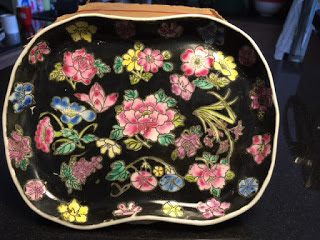
These tea sets are small.  They comprise of a tea tray, a teapot and 4 cups.  The size of the tea pot is about 80ml with 20ml sized cups.  I have collected quite a bit of these sets and I was fortunate that most of these sets were in their unopened, unused factory cardboard boxes.  I have the red 'Wan Shou Wu Jiang' (aka longevity), rice porcelain, black 'million flower' as well as a gold phoenix and dragon set.  Many of these sets were primarily made for export and in my opinion, it is more difficult now to find them in pristine condition.  I kept them as these sets marked a moment in time for Chinese tea history.  Maybe I was hopelessly dreaming I could be a zillionaire when I sell them in my sunset years.  

Brewing tea in these small sets requires me to be more deliberate in a tea session.  I find myself slowing down to prevent spills or even accidents.  Drinking tea from small teacups is a 'refreshing' style. I could get 2 small sips or a small mouthful of tea per cup.  It takes a meticulous effort to appreciate the aroma and taste from each cup.  If you had observed me having a tea session, it will appear I was like a kid playing with a tea set but I do enjoy the slow deliberate style in brewing and drinking tea from such tea sets.  It is for me, a few quiet minutes of bliss.   

Tuesday, June 15, 2021

2018 Wuyistar Da Hong Pao


I had recently opened a 2018 tin of Wuyistar Da Hong Pao. This black tinned edition is packed with 125g of oolong. I like tinned oolong that are double lidded as it does keep the oolong dry and somewhat airtight. This would help prevent the oolong losing its aroma or going flat in the taste.

I had tried Wuyistar's tinned version of Shui Hsien oolong and I am pleased with the the tea. Wuyistar has quite a good following of oolong tea drinkers and they offer a wide range of oolong to cater to their customers.

This tea goes for around $30-36 depending on where this tea is sold in your region. Such tea are getting expensive that 1 kg of this tea would cost $280 (if $35 per 125g tin calculation is used). Perhaps this is one of the reasons why smaller teapots are used to brew such oolongs.

This oolong roast levels are high. There is a nice fragrant aroma that stays in your mouth after a cup of this tea.  There was a flowery finish in the aftertaste.  This Da Hong Pao does, after brewing 6 infusions, weaken in hurry. A very decent tea.  I personally prefer Wuyistar's canned offering of Lao Chong Shui Hsien as it offers a more punchy and vibrant taste and aroma. Do let me know your thoughts on the Wuyistar oolong cans.

Tuesday, June 1, 2021

Lao Cha Tou


Lau Cha Tou? What is that? Lao cha tou is actually ripe pu erh tea. During the manufacturing process of fermenting ripe pu erh tea. Some of the tea leaves clumped together and looked like tiny nuggets or pebbles. Tea manufacturers would collect these nuggets from their many ripe tea productions and pressed them into bricks when there is sufficient quantity of these lao cha tou. 

I had just opened a 2007 Haiwan Lao Cha Tou. This tea came compressed in a 500g brick. The Taetea (Dayi) version, for your information, comes in a 250g brick.   Notice the tiny clumps of tea in the brick. 

There are not much reviews or write up on this tea.  Why is that?  As I had stated, lao cha tou is produced and made for sale once the tea producer had enough of such tea to put up for sale. This would imply that the producer would need to collect the tea clumps from many ripe tea productions. Haiwan and Dayi, in my opinion, are 'big time' producers of ripe tea on a yearly basis and more often than not, most lau cha tou sold are invariably from these 2 sources. 

Pu erh purists hardly review such tea. You can conclude that this tea would have subtle variations in taste and aroma in the tea. Not surprising as lau cha tou is a collection of various ripe tea.  These subtle differences can be discerned from different production years or from different bricks from the same production to differences within each brew. It is this inconsistency that tea purists avoid doing a serious review of the tea. 

I like this tea for this very reason.  It is a tiny surprise in every cup. This 2007 brick is already 14 years old.  The tea is smooth and mellow. There is sweetness, toasty and herbal notes in every cup. There are differences but the taste and aroma but on the whole, the tea does average out to a very pleasant tea session. 

I am tempted to buy more lau cha tou when I see them for sale again......I really miss travelling for tea.