Friday, November 23, 2018

2005 Changtai Bulang Raw Puerh Cake


2005 Changtai Bulang Raw Pu erh cake.  400g cake at $74.  18.5 cents/gram.

The above 'information' are used by tea reviewers to give the readers a summary overview of the cake that is being discussed.  

This information is good and is important to the reader.  You get to know the age of the tea and the tea factory that made the cake.  You can see that this cake is a 400g size.  And.... finally you get the price of the cake including a technical price per gram basis.  You can 'calculate' the costs per brew if you buying this cake.  If you are using 7g our session, you are looking at about $1.30 per brewing session.  

I think we can do more.  

When you buy pu erh tea, you are not only buying the tea, you are buying the storage.  

This 2005 Changtai is 13 years old.  This tea had been Malaysian stored for more than a dozen years.  This 13 years of storage should be an important feature in a assessment of this tea.  13 years of storage, in my opinion, is a pretty long time.  The tea would have some age in taste and aroma.  I would expect that the storage would comprise at least 40-50% in an overall assessment of the tea.  

And this 'assessment' is not easy.  There is the issue of different storage consideration.  This tea would taste and smell different under different storage conditions.  Such conditions would include different climate / countries where the tea is stored or even whether the tea cake is broken up and stored in a tea caddy or if the drinker chipped off a piece of tea to brew.  I myself find assessing a tea difficult.  When I sample a tea stored in Hong Kong, Kunming, Taiwan, Guangzhou, a same year Xiaguan tuo has considerable differences in taste and aroma.  It is not better or worse, but it is the result of the storage....and I would present the tea to the reader as it is.  I learnt / try to appreciate the tea and the respective storage.  It Is this uniqueness that should be appreciated and enjoyed.  The storage of pu erh tea should be / must be highlighted.  

Yes, my perceptions of the tea with regard to sweetness or bitterness or feel of the tea is subjective.  As a reader, you will also realise that your taste preferences are different and may change with time.  So I can only suggest - when you like a tea, it is a good tea.  And....a cheap tea can be a good tea.    A $1/g tea does not mean that it is 5 times more aromatic and tasty than a 20 cents/g tea.  For me, giving the reader the price per gram is just telling the reader how much a tea brew would cost to brew.  It does not indicate a bargain or quality.   Never use price to judge a tea.

But I digress. I would not mail out tea for about 2 weeks before Christmas.  No Haiwan spa for me this time as I will helping out in a poorer community in Vietnam.   If you are getting tea or exchanging tea with me during this time, please exercise some patience.  Thank you. 


Wednesday, November 14, 2018

Things to improve a puerh tea session - Part 2


Continued from Part 1 - link


3.  'Xin' Cha -  this is the Chinese term for awakening your tea.  I believe that  pu erh tea needs awakening at certain times.  Let me explain.

a). you would have read from the tea forums that many pu erh tea drinkers that had bought tea online found that  their tea tasted better after letting the tea rest for 1-2 weeks. 
When your tea had travelled for many miles and spent some time flying by air before your order reached your doorstep, it might be possible that your tea went into a moment of 'hibernation' and needed time to stabilise. I cannot provide a scientific explanation for this phenomena, but many of my tea friends 'swore' that tea was better after some time of rest.

b) I also propose that you break up your cake, too or brick into small pieces and store your tea in a tea caddy for 2 weeks before you start on the tea.  
You can do simple inexpensive experiment where you break up half a cake of your tea and place the tea pieces in a tea caddy.  Do a comparison testing after 2 weeks.  I am also unable to provide a scientific explanation, but tea stored in a tea caddy is more aromatic and tasty compared if you break off a piece of tea and brew up the tea.  

4.  Attend or have a small group pu erh tea session.  Many of us are 'home alone' tea drinkers.  We tend to brew and drink tea at home.  It easy and comfortable to drink tea alone at home.  You choose your time and brew whatever tea you like, whatever way you like; gaiwan or teapot and no one will say anything.  You buy your tea on the internet from round the world and may even participate in tea forums giving your thoughts on the tea.  

But I recommend that you join or conduct small pu erh tea drinking groups.  It is fun to share your knowledge on tea and at the same time, actually get to 'socialise' literally.  You get to see the different interpretations of tea in terms of tea brewing, tasting and other stuff like storage.  Do a tea exchange.  Yes, tea can be appreciated alone but as a group it is just as fun.  It is sad that many of us are 'busy' in this present 4G society.  We have more friends and followers on the internet, but to have friends that sit right across a table is more meaningful, in my opinion. Yes, there will be many things you may be uncomfortable or disagree when you have a tea session with fellow tea friends.  It is all in good fun.  
Invite me to one of your tea sessions. Who knows I will really appear.  By the way. I intend to / hope to visit my Czech And Scottish tea friends real soon.  They do not know it yet.  

Sunday, November 4, 2018

Ipoh Leong Swee Sang (Bliss) Liu Bao Tea


A collector had put this bag of Liu Bao tea up for sale last month in Malaysia and I had an opportunity to sample this tea. 

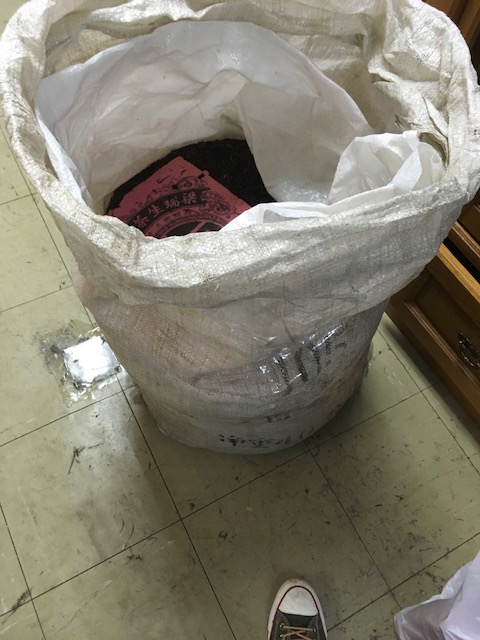
This tea is the Ipoh Leong Swee Sang Liu Bao.  It came packed, all 40kg, in a thick white bag.  The available literature was that this tea was exported through Hong Kong to Malaysia in the 80s.  Such Liu Bao tea in the 80s was a popular tea among the Chinese tin mining community in Ipoh from the 30s to the early 80s when the tin mines was depleted.  Note the big pink neifei with the Chinese 'fu' character.

This tea has a nice medicinal aroma and taste in the initial infusions.  Good for more than a dozen infusions, this tea now is expensive and highly sought after.  

Pix 2 shows the tea in its 5 or 6th infusion.  


Sunday, October 21, 2018

A Letter To James of Teadb


James Schergen is one of the most famous celebrity on the internet when it comes to Chinese Tea.  He appears on his own videos and his articles appear frequently  on teadb.org (link).  He had recently written to me giving his insight on my previous blog post about Chinese teapots (read my 2 latest posts).  I had given much thought and I decided to reply to him in a 'letter'.


Hello James,

Thank you so much for your thoughts about my Chinese teapot blog entry.  I am a big fan of your work and I tune in regularly to watch your tea videos.  I imagined myself literally sitting across the table while you are brewing and sampling the tea.  Sometimes, I shout out loud at the video to call you to reheat the water for your later infusions as cooler water might affect the interpretation of the tea.  It was in good fun.   I did hear on the grapevine that there is a possibility that you may coming to our shores.  I am so happy and I hope to see you and get you to sign autographs.....so I can sell them later to the many tea auntie fans that simply adore you and may even camp overnight at the airport to welcome you if you are really coming.

In your comment on Chinese teapots, you posed a question which literally caught me off guard - 

"Can a serious tea drinking person be into tea without owning teapots? This is a harder question, but I do think it is possible."

I actually was dumbfounded for several days.  In my tea drinking groups which I join in Singapore, Malaysia, Hong Kong and Guangzhou, we often discuss many things about tea and tea ware.  We would also debate on tea issues like storage but never whether a serious tea drinker can do without teapots. You had suggested that owning a teapot is a luxury than a 100% requirement.  

An old Chinese idiom - those who understand do not speak while those who speak do not understand.  Indulge me, James, for speaking as I really do not understand.  Here are my thoughts:

1.  Marshaln (aka Lawrence) the author of the the famous A Tea Addict's Journal (link) is the most respected and his articles in English and has a strong and steady following of readers worldwide. From reading his entries, I felt he was inclined to use a teapot than a gaiwan to brew his tea.  One of his entry on 25 Feb 2008 :

"I realized today I haven’t touched any of my gaiwans since I returned from Taiwan.

I remember I used to use the gaiwan for everything…. from greens to blacks. Gaiwan was my weapon of choice. Gaiwan was the only thing I’d use, pretty much.

Then slowly, I started using more yixing pots. I gradually bought a few more, and found them, somehow, easier to use. Maybe it’s because I will no longer burn my fingers, as I do once in a while with a gaiwan. Maybe they provide more aesthetic variety. Maybe they do make better tea?

On the better tea question, I am now quite certain that some yixing pots will make softer tea (whether that’s better or not is up to individual taste). I’m still not sure exactly what goes on in a yixing pot that actually changes the tea. There are many theories out there, from temperature retention (sort of true…) to pores in the clay (really depends) to seasoning (maybe true, maybe magic…. and also depends, greatly). Gaiwans, though, still give you an “honest” tea, without really messing with the tea in any particular way. "

Is Marshaln a serious tea drinker?  Yes!  He is the master sifu of tea.  He had invited me once to his palace and his collection of teapots he use for brewing tea is pretty impressive. 

2.  During one of my tea drinking sessions in Guangzhou a few years ago.  A retired manager of CNNP who was in this tea drinking group had remarked that the invention of the Yixing teapot was one of the best things for Chinese tea.  I find that his thoughts are appropriate in this discussion.  

3.  I spent last Tuesday morning at a local teashop in Chinatown and I posed this teapot question to the manager there.  Instead of answering my question, the manager asked me to sample an old shui hsien with her. The manager used a gaiwan and a teapot to brew the oolong (see bottom pix) and we proceeded to sample the tea.  Tea brewed from the gaiwan seems more aromatic while the tea from the teapot was very smooth in the taste and finish.  

Personally, I use teapots to brew my tea at home.  I have a few gaiwans and hardly use them.  Many serious tea drinkers I know use a teapot than a gaiwan.  I do not see a teapot as a luxury.  

I had also noticed that the gaiwans used for tea sampling at teashops tend to be better quality gaiwans.  Many believed that the older gaiwans made in the 90s or earlier are very suitable for sampling tea.  Maybe it is the glaze or the quality of the raw material.  These gaiwans can be expensive and asking prices for these old gaiwans can be a few hundred dollars each.  

You mentioned that 'good Yixing can improve' a tea session.  However, I interpret your argument that you find that this improvement or difference as not significant or dramatic enough to warrant that; using a Yixing teapot is 100% necessary.  I respect your view even though I disagree with it.  

Do look out for me at the airport, if you are coming to our shores, as I will be standing with your hoard of screaming auntie fans to welcome your arrival.  It will be a dream meet for me.

Your fan, 

Wilson


Wednesday, October 10, 2018

Can a serious tea drinking person be into tea without owning teapots?


Tea celebrity James of TeaDB commented on my previous blog entry and his comments are reproduced in full below. I shall give my reply in another blog. Thank you, James for your thought provoking comments.


Hi Wilson,

I think you referenced one of my recent posts. I think we mainly agree about most of this. But in regards to the importance of teapots, I'd respectfully share a few of my thoughts and push back a little bit.

In my opinion, good Yixing can improve a session. I also use Yixing for a significant majority of my own sessions so I'm certainly not a total skeptic. I also do believe that it's importance can be overly inflated.

My post was written towards people newish to Chinese tea and/or pu'erh. The cost of good clay pots can be quite high and getting a $200 teapot is often seen as a significant barrier towards trying Chinese tea, when I think it'd be better if it wasn't.

From what I've seen, a fair number of people just starting will end up with cheap pots that they'll stop using at some point. You could argue this is necessary just as tuition tea is.. But.. I'd argue newer people would be better off focusing more on tea rather than concerning themselves with the intricacies of the teaware market.

Can a serious tea drinking person be into tea without owning teapots? This is a harder question, but I do think it is possible. I have a good tea friend that's been into tea for several years.. They have a couple pots, but when resources are limited he just about always ends up buying tea. Having old, nice pots is a nice thing to have but I also don't think it is a 100% requirement to be considered a serious tea person. I'd argue it is a luxury more than a 100% requirement.

Respectfully,
-James


Sunday, October 7, 2018

Believe It Or Not ! Things To Improve A Puerh Tea Session - Part 1


I have mentioned on many occasions that there are inexpensive ways (or things I did) that had improved my puerh tea brewing sessions while I was brewing tea at home.  The following ideas or methods are not expensive to do and I would like to share (repeat) these ideas again in this blog entry.  The improvements might be very very tiny, hardly noticeable but can be discerned by a pu erh tea drinker.  

1.  Water.  I use tap water for my tea.  Chlorine was added to the water (during purification) to make it germ free.  The chlorine scent is quite pronounced especially when you fill a jar, cover it and returning to it 15-20 min later.  I use a filter (simple gravity type) to remove this smell.  Another way to remove chlorine is to fill a jar of water and leave it overnight.  Drinking chlorine free water does improve the taste and aroma of the pu erh tea.  I know a few tea friends that went the extra 'mile' by placing mineral stones or charcoal pieces in the water jar.  

Another inexpensive method is to use boiling water for brewing all your pu erh infusions -  raw or ripe.  Even for later infusions, start up your stove again or let the kettle reboil before brewing your tea.  I feel that I could get a wider aroma profile from just using boiling water.  Ideally, if you can get a kettle of water and get it to slowly simmer (low boil) throughout the tea session...is best.  I am sure you had noticed some friends, teashops or even video where the water is never reboiled after the 1st infusion and the water gets 'cooler' with subsequent brews.....the tea taste and aroma is affected by the lower temperatures and the interpretation of the tea in my opinion is compromised. Reboiling a hot kettle of water only take a few seconds and your tea would taste better with this extra effort.  

2.  Use a Yixing teapot to brew your tea.  There is a big difference between using a gaiwan and a Yixing teapot when it comes to brewing pu erh tea.  A Yixing clay teapot will enhance the taste and aroma of your pu erh tea.  Perhaps it is the tea patina from constant using of a teapot, that had improved the taste of the tea.  Maybe, the teapot holds the temperature well (preventing the tea from cooling too fast)...or maybe it is the interaction of the clay with the tea.  (Incidentally, I also found that purion teapots made by Lin Ceramics seem to make my pu erh tea more amplified in the aroma and taste.)  Buying a Yixing teapot may be an expensive proposition.  You would be looking at prices from $50-200 for a Yixing teapot.  But....if you are careful with it, the teapot can give you many happy brews of your tea.  I have a few teapots that I have used and brewed tea for more than a thousand times.   I had personally found, I could use a Yixing teapot to brew either ripe or raw tea and I could not discern any inconsistency in the tea when I used such a teapot.  I recently read an article that using a teapot is not 100% necessary and that using a gaiwan is good enough.  You can brew a tea anyway you want even throwing some leaves in a cup, adding hot water and drinking the tea later, but to enhance the atmosphere of drinking and appreciating Chinese tea, a teapot is an important utensil that serious tea drinkers cannot do without.

To be continued.

Sunday, September 16, 2018

An Old Taetea Dayi Raw Tuo


This is a 2005 Taetea Dayi raw pu erh tuo.  Yes, many Chinese pu erh tea drinkers would normally associate the compressed 'tuo' (or bird nest) shape with Xiaguan tea factory.  You are absolutely right that Xiaguan produces a very wide assortment of pu erh tuos every year while other pu erh tea factories often mainly produces and compressed their pu erh tea into cake or disc shapes than tuos.  

Taetea (aka Dayi) do compressed their pu erh tea into tuos on a smaller scale.  This 100g 2005 raw tuo had been stored in Malaysia for about 13 years.  Composed of mainly Menghai material, this tea when brewed coat the mouth easily; an almost oily mouthfeel.  This tea is floral in aroma and has a pleasant mild sweet finish and aftertaste. Good for 10 infusions.

But I digress.  Tuos compared to cakes are more difficult to dismantle.  I find that I get more tea dust after I break open a tuo.  The compression of a tuo tend to be 'looser' after about more than 12 years of storage in this part of the world and the tuo becomes easier to pry open.  Pu erh pressed into tuos are less popular with collectors than pu erh cakes.  My guess cakes are visually more appealing, bigger and feels more value for money due to its size and weight.  However, the tuo shape pu erh is a hallmark of the pu erh tea industry.  There is no discernible difference in the taste and aroma of the pu erh tea.  I have yet to meet a drinker, that can tell from drinking a cup of puerh, that the tea was compressed as a tuo or not. 

Let me know and share your 'tuo' experiences with me.