Tuesday, April 21, 2015

Cheung Hing Tea Shop Tie Lohan


My new tea friend Richard Zhang who operates Viconey Tea in China gave a very good description on oolong tea

"Wuyishan Mountain is an amazing Kingdom of tea trees. It produces countless tea cultivars. For hundreds of years, among them, some ones are considered having supreme character. Tea lovers usually call them "Ming Cong"(Famous Bushes 名枞). Yancha made of Ming Cong features rock charm and tastes mellow, thick, sweet and brisk, mixed with a flavor of wild tea. Its soup is orange yellow and bright. Mingcong tea tree requires an ideal environment, so most of them grow up in Mingyan producing area. There are four Ming Cong which are seen best and called "Si Da Ming Cong"(Top Four, 四大名枞). They are Da Hong Pao(大红袍), Tie Luo Han(铁罗汉), Bai Ji Guan(白鸡冠)and Shui Jin Gui(水金龟)."

There you have it. Tie Lo Han is one of the major oolongs of China. However, buying Tie Lo Han from Wuyishan would be an expensive proposition as demand exceeds the small supply of oolong that is produced in that region. Most of the 'Ming Cong' oolong teas that we drink would most probably be from the tea growing regions at the lower altitudes of Wuyishan and possibly even at the outskirts of this region.

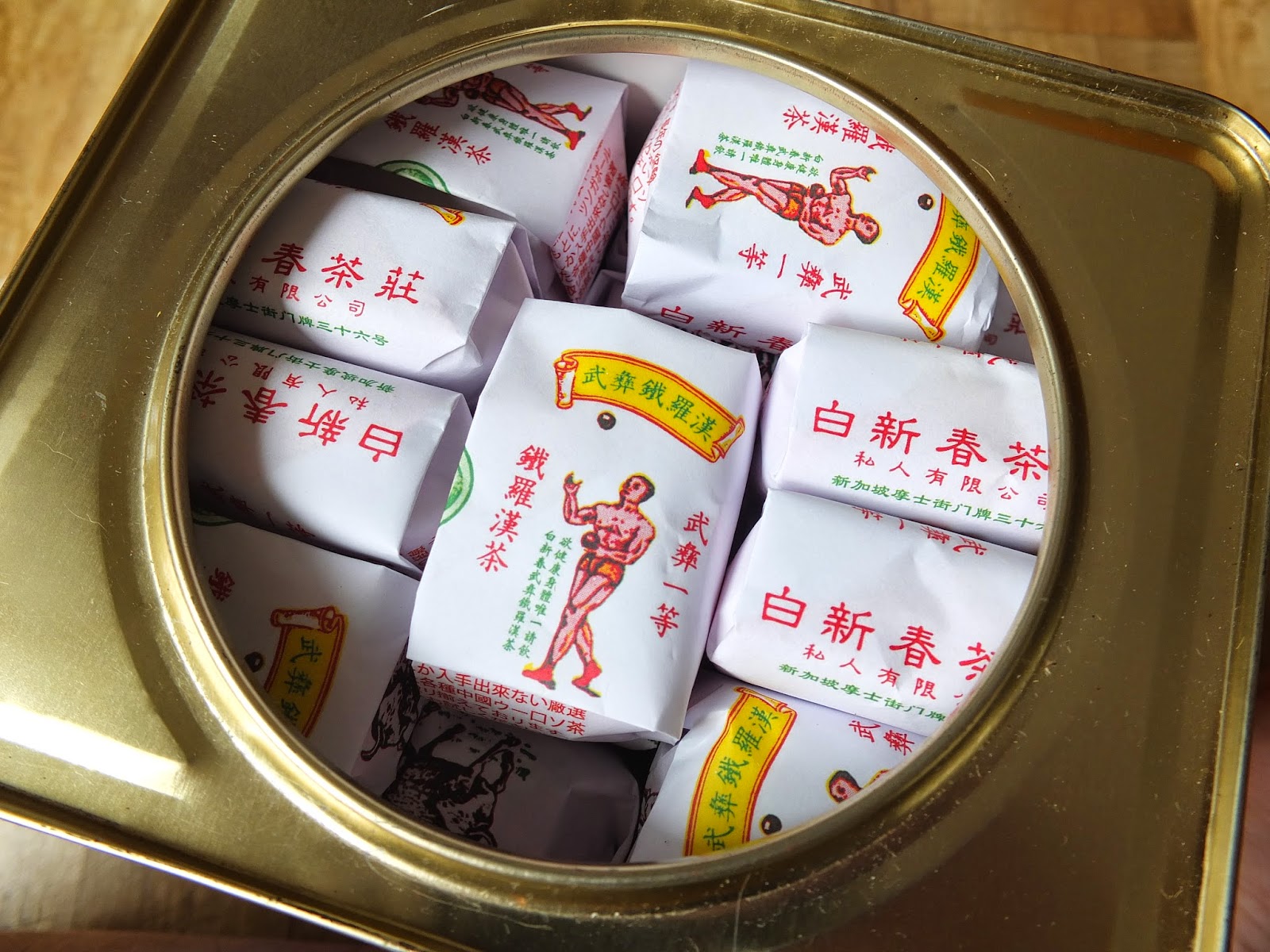
Cheung Hing Tea Shop in Hong Kong sells their Tie Lo Han in small hand wrapped packets of about 6.5g each. These packets are further packed in a bag of 10 and 8 of these bags are bagged again and sold as a larger bag.

I liked this Cheung Hing tea as this high roasted Tie Lo Han exudes a woody and herbal scent, reminding me of a nice traditional Chinese herbal tea. I felt this tea was memorable in a sense that the flavor and aroma stays in the mouth after a tea session and leaves a pleasant reminder of the tea. This tea can brew up about 6 infusions before weakening in a hurry. I had earlier sampled an older packet of this tea and found it more mellow. I shall try to keep aside this tea in my tea cupboard.

It was interesting while I was in Hong Kong, another tea shop there classified and sold their Tie Lo Han as old Shui Hsien (another Chinese oolong). One other shop even told me that their Tie Lohan is a blend of oolong tea. These shops had been around for many years and have a loyal following of customers who knowingly purchased these tea. I had tried their tea and they are very good. I have no qualms about this issue. To me, as long you are happy with your tea, it is a good tea.

The last pix shows the 4 Tie Lo Han tea in my collection. From top left in a clockwise direction; these are the Hong Kong Cheng Hin, Sea Dyke and the lower 2 from Singapore from Koh Kian Huat tea merchant and Pek Sin Choon. Noticed that all these 4 teas are individually hand wrapped and are sold in a larger packs or tins. All 4 Tie Lo Han are different especially in their aroma and roast levels.

Which Tie Lo Han should I brew today?

Tuesday, April 14, 2015

Tea Art Magazine No.52


I managed to get the latest copy of the Tea Art magazine while I was in Hong Kong last month.  Issue No. 52 is an almost 500 page magazine.  This book mainly concentrates on Pu erh and teapots and most of its contents are advertisements taken out by Chinese tea companies and tea shops.  My Malaysian readers would be happy to see a Malaysian ad.  You see Veronica Chan advertising her liu bao tea shop located at Damansara, Malaysia.  

Yes, one article covered the opening of Lau Yu Fat 2nd tea shop located at Central, Hong Kong.  Operated by Yik (younger Lau), I managed to get him to initial his name on the page of the article.  

Another article dealt on the various unique tea rooms or places to brew your tea.  You can now brew your tea in a tree house, on a boat and yes, even in a cave.  

This magazine even had an article on tetsubins or iron cast kettles.  These kettles had been gaining popularity among Chinese tea brewers as the water boiled in such kettles tasted much softer and helped enhanced (psychologically?) the tea session.  Ahem... I purchased a Chinese tetsubin during my trip last month.  

A reader asked me about my outlook on Chinese tea this year.  I noticed that China Tea Co (CNNP) is  starting to making a strong presence.  While in Fangchun, many of its tea products especially its black tea are now being promoted in Fangchun.  I noticed more shops now selling CNNP black tea in bricks or logs.  I also noticed a few shops carrying more of China Tea pu erh products as well.  

I think for pu erh prices, pu erh tea produced pre 2005 will continue to appreciate upwards.  Both raw and ripe (yes ripe teas) are showing good demand in the secondary markets.  Newer post 2008 pu erh will not see much price appreciation as these teas are still available and stored in quantities by collectors and tea shops.  I am sure that more than 50-60% of the big brands pu erh produced yearly (post 2008) are not consumed and are stored away in warehouses.  There is a consensus among Fangchun tea shop owners that new 2015 pu erh tea will be slightly cheaper this year (and maybe next year as well) due to reduced speculation and lower demand.  The weaker Chinese economy would dampened tea prices which may be good news for us, the tea drinkers and collectors.  For the oolong market, traditional high roasted tea are making a very strong comeback.  There is hardly any demand for light roasted oolongs.  While I was in Hong Kong, a few tea shops that dealt with traditional high roasted oolongs noticed a significant spike in demand from overseas like  Korea, Taiwan and even Malaysia for their high roasted oolongs. I may make another trip to Guangzhou and Hong Kong later this year and will keep my readers updated on the trends and prices of tea there.    


Sunday, April 5, 2015

2004 CNNP Bada Blue Peacock


I had purchased a tong of these cakes when I was at the Malaysia tea expo in Kuala Lumpur last December.  This tea was on promotion and there were only 8 cakes (an unopened tong and 1 cake) left 'on the shelf '.  I decided to buy the lot.  An impulsive buy.

I had made many tea purchases that were a miss than a hit.  This purchase, fortunately was a value for money purchase when I tried this tea at home.

This tea had been well stored in Malaysia.  Breaking up the cake produced a dry crispy sound and the appearance of the cake looked good for its age.  My readers would know that I prefer my raw pu erh with a smoky background, but this cake was 'smoke free'.  Brewing this tea produced a citrusy aroma reminding me of fresh lime.  Not overpowering but its somewhere in the scent.  I liked this tea in that I felt heated up after drinking a few infusions, like I am going to break into sweat. Chinese tea drinkers refer to this sensation as being caused by the 'chi' or energy of the tea.  I had observed that some of my friends sweating literally when they drink 'chi' powered puerh.  My friends tell me their backs starts to sweat and even may have beads of sweat on their forehead……and my friends actually enjoy and look forward to drinking such teas.  

Back to this tea.  This pu erh is produced by CNNP (aka Zhong Cha brand) and has a blue peacock printed on the wrapper.  This cake, as described in the neifei, is made from pu erh harvested from Bada region in Yunnan.  This tea when brewed exhibited a nice dry woody character, and when combined with a hint of citrus aroma,  made this pu erh an interesting brewing session.  This perhaps is one of the reasons why I go overseas for my tea adventures.  I get to explore the many types of tea while at  the same time making new friends who are passionate over their cup of Chinese tea.  

Sunday, March 29, 2015

Guangzhou Adventures - A Smoky Xiaguan Morning


I sampled 2 Xiaguan pu erh teas during a morning while I was in Guangzhou.

I had the opportunity to sample the 2003 Xiaguan iron cake and the 2006 mushroom tuo cake.  Both are raw pu erh and you will observe from the above pix that these 2 forms of tea compression are usually found in Xiaguan pu erh tea products.  Xiaguan tea factory commonly compressed their pu erh tea into cakes, small tuos and bricks.  Sometimes, the pu erh tea are compressed into iron tea cake and mushroom shaped cakes.  

This iron tea cake I tried is the 2003 version.  You do not see the 'Xiaguan' name on the wrapper but the tea factory's name is printed on the neifei or inner label on the cake.  I believed 'Xiaguan' changed to their own wrappers in 2005. A retired CNNP manager friend told me that the use of machines to compress these iron cakes came from Russia technology and to this day, iron cakes are considered the highest compression pu erh tea cakes.

The mushroom shaped tea is a 2006 production.  Weighing in at 250g per tuo, these tea are packed in threes into a paper bag.  Notice the tibetan flame logo, which indicated that these tea was primarily produced for export to the Tibetan regions.  There, the people have little access to green vegetables for their fibre intake and the tea was drunk as a digestion aid.  Butter, spices, salt and sugar were added to the boiling tea and are drank frequently by the people there.  Nowadays these tibetan flame tea are also appreciated by Chinese tea drinkers and such tea are now available in many tea shops in China and in countries like Malaysia and Hong Kong. 

Before I sampled these Xiaguan teas, I was happily thinking that I would have an exciting smoky Xiaguan morning and looked forward to drinking these older tea especially the 2003 iron cake.  Yes, it was a wonderful smoky experience but I was surprised that the 2003 iron cake tasted newer than the 2006 mushroom tuo.  I believed the high level of compression of the iron cake was the main reason for the newer taste.   This would suggest that only the tea leaves on the surface of this cake aged well while the leaves under the iron cake's surface aged very slowly as hardly any humidity could 'get through'.  The mushroom tuo, had a nicer aged taste but tasted a bit rough as more chopped tea leaves were used in the making of this tuo.  Even though  my tea friends and I believed that better or whole tea leaves were used for the iron cake, most of the tea  leaves would had been broken when I forcefully pried off some of this tea for a brew.  However, I found the taste profile was better in the iron cake……liked there were more flavors in the tea.  It was a nice morning going though about 10 infusions of each tea….savoring every cup and every drop.

But I digress…..today is the funeral of Singapore's Lee Kuan Yew, former prime minister of Singapore.  He had been credited with transforming Singapore within 50 years to achieve top world rankings in terms of economy and finance, education, investment and standard of living.  Time magazine had written many articles about Mr Lee and he had even been on their covers on a few occasions. Requiescat In Pace.


Sunday, March 22, 2015

Guangzhou Adventures 2015 - Fang Yuan Pai Teapots


I took a vacation last week and spent 10 days just exploring tea in Guangzhou and Hong Kong.  It was an unusually pleasant experience to drink so much tea all day long.

I was privileged that I knew a collector that owned some Fang Yuan Pai teapots.  Fang Yuan Pai teapots were the only authorized teapots that were made for the commercial market during the communist era in the 1960s to early 1990s (link).  He allowed me to handle his collection and photographed them.  I had bought one of my teapots there and included it in a teapot group photograph (pix 15).

My collector friend even treated me to one of his rare teas, a green tea called Jing Shan Tea.  This tea is grown by monks at Jing Shan temple near Hangzhou and is mainly drank by the monks in the temple.  Devotees are sometimes given these tea when they visit the temple.  These tea are produced in small quantities and are not for sale.  Notice the unusual curled tea leaves.  I found the tea fresh tasting with nutty characteristics of a good longqing tea.   

Thursday, March 12, 2015

2008 Dayi Taetea Lao Cha Tou


Lao cha tou is actually ripe pu erh tea.  During the manufacturing process of fermenting ripe pu erh tea.  Some of the tea leaves clumped together and looked like tiny nuggets or pebbles.  Tea manufacturers would collect these nuggets from their many ripe tea productions and pressed them into bricks when there is sufficient quantity of these lao cha tou.  I did noticed, during the course of my tea travels in China that lao cha tou were also sold in loose form.  

This is the 2008 Dayi lao cha tou.  These were sold as 250g bricks.  I remembered that Haiwan had in 2007, also produced their version of lao cha tou that came in 500g bricks.  I bought more of the Haiwan bricks as the prices were similar to the 2008 Dayi but as Haiwan was 500g, it was my opinion Haiwan gave more value for my money (link).

A single brew of lao cha tou can easily make 12-15 infusions.  This Dayi tea is no different.  As lao cha tou tend to have 'off' flavors in the first few infusions, I normally flash rinse such tea 3 times, drinking only from the 4th infusion.  This Dayi tea is very easy to drink exhibiting fresh toast bread aroma with nice subtle sweetness in the tea.  A comforting tea to have after dinner and through the night if you need to stay up.

Saturday, February 28, 2015

Traditional 50 Packets Of Tea In A Tin


There are a few Chinese teashops in SIngapore whose main business is in the supply of Chinese tea to restaurants and eateries in Singapore where Chinese tea is served.  Local readers will know Chinese tea will normally be served at Chinese wedding banquets or company events when held at Chinese restaurants or hotel ballrooms.  

Pek Sin Choon is located in 36 Mosque Street (Chinatown).  Established in 1925, this company is the major supplier of Chinese tea to eating establishments.  Most of the bak kut teh stalls (refers to pork rib soup) that offers Chinese tea will normally be carrying Pek Sin Choon supplied Chinese tea.  I will devote a blog on such stalls later this year.  

Koh Kian Huat Tea Merchant is another Chinese tea supplier.  This company was founded in 1918 and is  located in 531, Hong Lim Complex #02-38 (in Chinatown too).  

I liked these 2 teashops as they are still continuing the tradition of packing their tea in small paper wrappers and packing them in a metal tin.  As you will observed from the pix, a tin of tea will have 50 hand wrapped tea packets (12g per packet or 600g per tin).  Oolong tea are usually packed in such tins and you have a choice of Tie Guan Yin, Shui Hsien or Tie Lo Han.  

I purchased the Tie Lo Han oolong from these two shops.  The Koh Kian Huat version was on the heavy roast side.  Woody character with a mild sweet aftertaste.  The Pek Sin Choon oolong roast levels borders between heavy and medium roast.  It is more fresh tasting in character due to its lighter roast.  I brewed these two teas during Chinese New Year last week and my guests even requested for a few oolong packets to bring home.   A happy testimony of these tea.  

Yes, readers.  This is the Japanese tetsubin which has the rust issues inside the kettle.  I will work to get this tetsubin operational again.