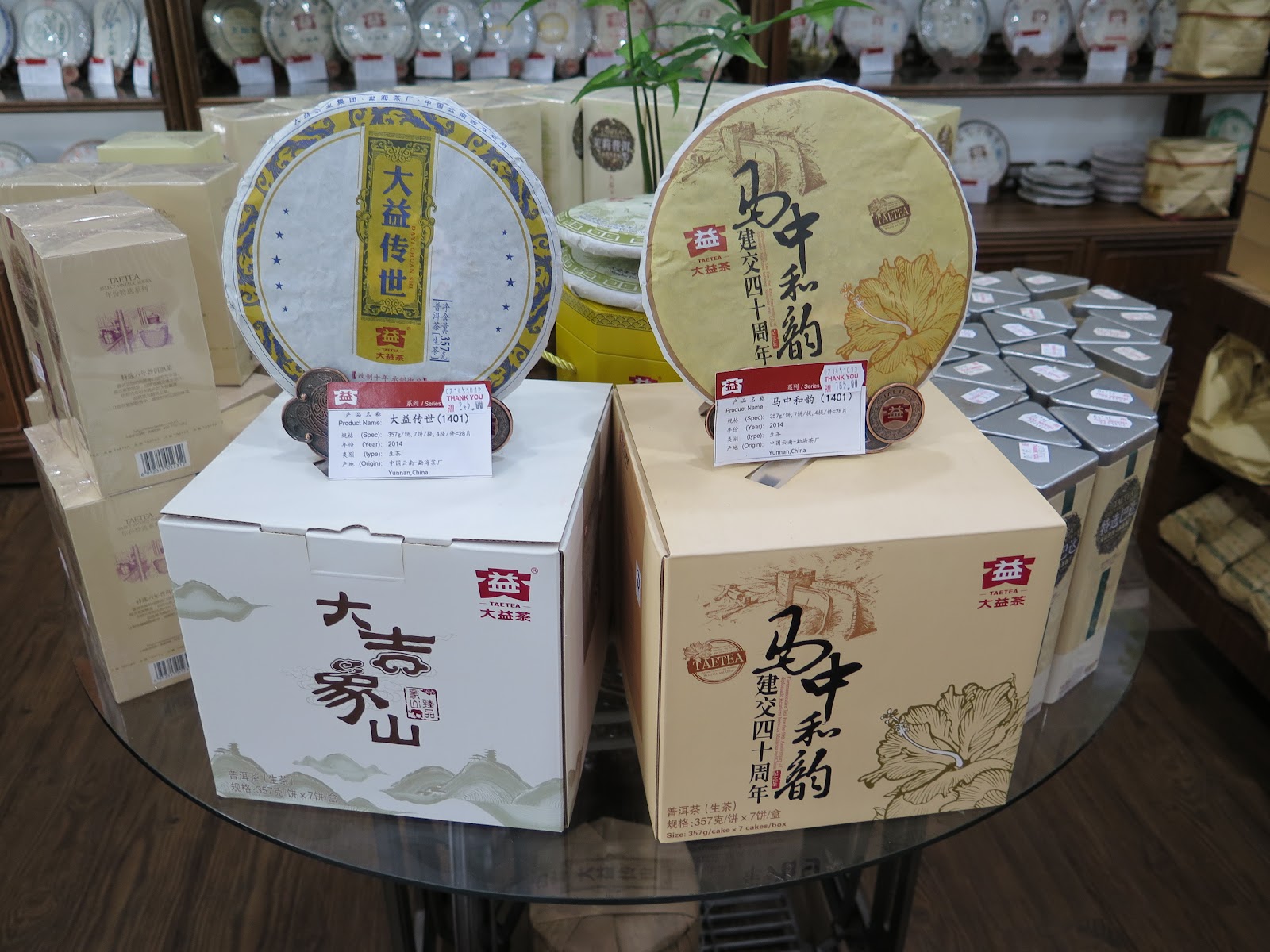


I was on a business trip last month and I had managed to squeeze one afternoon in Kuala Lumpur to meet my old tea buddy Auhckw for lunch. As we were in the Kepong vicinity, Auhckw bought me to JDX teashop, the first distributor of Taetea (we tea drinkers call this brand 'Dayi') in Malaysia.
This very big teashop is now transformed into a Taetea showroom. It is massive - a Dayi wonderland. It's much bigger than the Dayi shops I had visited in Guangzhou. I would recommend a visit for any Dayi tea drinker or collector if you are in Malaysia and get your Dayi tea refills here.
Dayi tea is very popular among Malaysian tea collectors. Many Dayi tea friends I know, actually invest by buying cartons of Dayi tea and selling them for a tidy profit when the prices of their tea appreciates. I know that some of these older Dayi tea are re-exported back to China as well. One of the main reasons is that the year-round hot and humid climate of Malaysia is conducive to pu erh storage and many tea drinkers think that a pu erh tea cake stored in Malaysia ages twice as fast than a same tea stored in China.
Well I am happy that I am living in this region and I can easily have my fill of Malaysian stored tea.
Address of the JDX teashop in Kepong:
44, Block C, Vista Magna, Jalan Prima, Metro Prima (Jalan Kepong), 52100, Kuala Lumpur, WP Kuala Lumpur, Malaysia
Tenmoku tea bowls are characterized by a thick glaze on the surface (both inside and outside) of a bowl. Tenmoku bowls had its origins in China, where Japanese monks had visited Chinese temples (experts think monks, during the 13th century, had visited Tian-mu temple in China, hence the name 'tenmoku') and bought back these tea bowls (and I imagine some Chinese tea as well) when they returned to Japan. Subsequently, these bowls were very popular with the Japanese and they started to make their own versions of tenmoku.
I had purchased a few tenmokus. The top 6 pictures are Japanese tenmoku bowls while the last bowl at the bottom is made in China, where such bowls there are called Jian ware.
I would like to share two observations of these tea ware :
1. The glaze on the bowls were thickly applied and highly reflective. The presence of iron oxide in the glaze may cause, intentionally, beautiful patterns on the glaze after the tenmoku had gone through its firing process. Depending on the heating and cooling times of the firing (baking) process, these tea ware will have very unusual and artistic results. Pix 6 shows an oil spot glaze, known as yuteki. The pattern of the glaze on the last pix is call 'rabbit fur or hair' design characterized by very fine lines resembling the coat of a rabbit. Readers, please click on the pictures to have an enlarged view.
2. Some of the Japanese tenmoku tea bowls comes with a metal rim. These rims are usually made from silver. You can clearly see these metal rims in pix 4 and 5. Why a metal rim? My best guess is the metal rim was made to protect the very fine and thin temoku bowl rim which may be easily chipped off during handling of such bowls. Rim chips may make drinking of tea from such bowls unpleasant and will affect the overall aesthetic appearance of these bowls. I found the installation of these metal rims to be high quality and it does not in anyway, affect me when I drank tea from such bowls. Almost unnoticeable.
Did you notice the tea bowl holder in the first 3 pix? This is a tenmoku dai, a holder to rest the tea bowl. These dai may be made from wood or lacquered in this case. I suppose some of these tea bowls have such narrow bases or bottoms, and may cause the bowl to topple to its side, spilling in its contents if one is not careful and a tenmoku dai will help reduce such accidents.
Drinking tea from these tea ware are very popular in China and Japan. These tea drinkers attest the tea would taste better in terms of aroma and taste. Moreover, the aesthetic factor will be turned up few notches when such bowls are used in a tea session.
Time to drink my pu erh from a yuteki oil spot tenmoku.
This very interesting article, written by Tee Lin Say, appeared in The Star Online on 3 Oct 2015.
http://www.thestar.com.my/Business/Business-News/2015/10/03/Investing-in-tea-leaves/?style=biz
Investing in tea leaves
Malaysia is deemed as the best place to store tea as the tea fetches a better price than that stored in Indonesia or Thailand.
BACKED by a 2,000-year history, Pu’er tea is among China’s top ten and has increasingly become an attractive investment for tea lovers today.
The market for Pu’er tea is relatively small, with only about 20 million to 30 million consumers worldwide. However, with Pu’er tea generating an average compounding return of 10% a year, the trend of collecting Pu’er tea is becoming increasingly popular.
Hai-O Enterprise Bhd executive director and chief operating officer Tan Keng Kang has been an avid tea collector since he was 14, While he was initially influenced by his parents’ love of Chinese tea, today, he is the tea expert for Hai-O and is also the president of the Pu’er Chamber of Commerce in Malaysia.
As a boy, Keng Kang remembered his father, Tan Kai Hee, who is the managing director of Hai-O, buying over a tea company – Chop Aik Seng Sdn Bhd – that had already been in existence for 100 years. Thus, after school, Keng Kang would head to the Chop Aik Seng tea shop to do his homework. Just for fun, he bought a few discs of Pu’er tea.
“It was really cheap, under RM10. And I remember that without having to wait very long, in about one to two years, my Pu’er tea had doubled in price! At that time, I felt it was such a windfall. This fired up my interest in Pu’er investing,” says Keng Kang.
Keng Kang started researching the different teas when he was 14. He also noticed another trend – while people would buy a few packets of Ti Kuan Yin tea, they would be buying Pu’er tea by the cartons. Why was this so?
First of all, the Ti Kuan Yin tea is best consumed within a year. On the other hand, the older the Pu’er tea, the better. It can even be kept for 100 years to be passed down to the next generation. Like wine, the older the tea, and depending on its place of origin and how it was manufactured, Pu’er tea becomes a lot more valuable over time.
Pu’er tea is generally categorised as green Pu’er and black Pu’er. Green Pu’er is non-fermented, while black Pu’er is artifically fermented.
Historically, Pu’er tea a top China tea, abundantly produced in Yunnan Xishuangbanna and Simao, and other south-western counties. Records of Pu’er tea date back to as early as the Eastern Jin Dynasty (317–420 AD), and records of the Tang Dynasty also show Pu’er tea trade.
Another reason for the tea’s popularity is its claims of health benefits.
Meanwhile, another major development for Pu’er tea took place in 1995. Prof Deng Shihai from Taiwan published a book entitled Pu’er Tea, which until today is considered the bible and authority on Pu’er tea. The publication of this book immediately increased the awareness and interest in Pu’er tea.
Keng Kang says he read every single word in the book and became even more interested in seriously developing the Pu’er trade.
“Although Pu’er tea is not traded in the open market, it is not difficult to find a buyer. First of all, it is real and consumable. If you have a packet of Pu’er tea from 1960, how can you replicate it? There is the place it was grown, the season and how it was plucked, among many other factors, to be considered. Once it is consumed, the tea is gone forever,” says Keng Kang.
Another example of a good investment made by Keng Kang was in 1996, when he bought 400 discs of Blue Label Pu’er tea for RM15 each. Today, each piece fetches some RM7,500.
So, how often does Keng Kang buy his tea now?
“That’s difficult to answer. How often do you buy your shares? As and when I see opportunities,” he answers.
Hai-O currently has a very substantial collection of Pu’er tea worth tens of millions. Keng Kang also has a private collection.
Among the tea on display in Hai-O are two valuable ones – a Red Label Pu’er tea manufactured in the 1950s, which is now going for RM250,000. He has another one, the Song Ping, manufactured in the sixties, which is now going for more than RM50,000 apiece.
In recent years, Hai-O has championed the “Malaysian storage” concept for Pu’er tea because of ideal weather conditions in Malaysia.
“Malaysia is the best place to store tea. The tea stored here always fetches a better price than the same tea stored in Indonesia or Thailand, for example,” says Keng Kang.
“If we are able to successfully market the idea that Malaysia is the best store place for tea, then we can eventually set up a facility to store all these tea. From there, we can develop Pu’er tea to make it a tradable commodity.
“My ambition is to create a standard for Pu’er tea, and for Hai-O to become the authority on Pu’er,” says Keng Kang.
Old man Lau of Hong Kong Lau Yu Fat teashop introduced me to a 2005 red mark pu erh cake for sale at his shop. This is a 'Zhong Cha' brand cake produced in 2005.
Mr Lau explained that this cake had been stored in Hong Kong (HK) for 10 years. The unique selling point is that this tea was 'Hong Kong' stored for the 1st 4 years and later dry stored for its subsequent 6 years.
Let me explain. 'Hong Kong' storage refers to pu erh tea being stored in warehouses or stores where the humidity of the storage area are naturally higher than the natural weather of Hong Kong. Old warehouses are normally located near harbors (for easy import and export). Older warehouses or shophouses may have basements as well for more storage of goods. These warehouses and basements are normally more humid and pu erh stored in such places will age but with a humid or damp characteristic where a tea drinker can easily detect from the aroma of the tea. The result is that, in my own opinion, is that the pu erh tea will develop a unique taste, that somewhat taste older for its age. I would like to warn my tea readers, if you had not tried such tea, that this HK stored pu may be an acquired taste - you may like or dislike it.
When I brewed a session of this Zhongcha pu erh, there was an added dimension of HK storage aroma and taste. The tea does taste more aged than a normal dry stored 10 year old cake. This is an interesting cake.
If you like pu erh, you should try to have some HK storage tea in your pu erh collection. It will serve as an important reference point for pu erh stored under unique storage conditions. It is interesting to note that many pu erh tea drinkers classify HK storage as traditionally stored. Many old cakes made in the 1960s through 90s enter Hong Kong for the domestic market or were later re-exported again to other countries for consumption. It would be no surprise if some of these cakes had some 'traditional storage' characteristics in the tea.
Let me see whether I can get more HK storage cakes to share with my readers.


The Chinese mid autumn festival is this weekend and moon cakes which are normally eaten during this festive occasion are easily available one month prior to this fun event.
Grrr! My local favorite moon cake now cost me $10. Each! Singapore is the most expensive city in the world to live (2015 EIU reports) and my mooncake price clearly reflects this unenviable expensive title. Picture shows a green tea filling cake. Mooncakes are traditionally filled with sweetened lotus seed paste but now everywhere you go in Singapore, there are durian, chocolate mousse, ice cream and tea flavored cakes for sale. Earl grey, matcha, milk tea and green tea are examples of tea flavored cakes.
A recent local newspaper article (The New Paper, 13 Sept 2015 - Is the price right? by Khairiyah Amirah Md Ramthan) highlighted the price of gold yin zhen tea (silver needle) selling at $850 per 50g (about US$600). The reporter made a mistake when he priced a cup of tea at $178.50 based on 2.5g of tea. It should be $42.50 a cup. The article explained that the silver needle tea leaves are plated with 24k gold. Available at TWG Tea.
It is really pricey, especially to me, that a cup of tea costs above $40.
I would like to ask my readers a question - How much does it cost for you to have a tea session? Specifically, how much is your tea per tea session?
This is a fun exercise. I just want to show that prices of tea had risen over the past few years. Examining price of tea per tea session, is to me, an interesting measure of the cost of tea to a tea drinker. Do remember to allocate the freight costs to your tea if you are buying online. It would give an even more accurate figure.
If a pu erh tea cake weighs 357g and costs $50, you should be able to have about 50 tea sessions if you used 7g of tea in a brew. That will cost you about $1 per brewing session. Likewise, for a oolong tea drinker, if you are using 5g of oolong per brew, your $50 100g oolong pack would imply $2.5 per tea session.
I hoped you had reached similar conclusions about tea prices when you did this exercise:
That good tea need not necessarily be expensive. If you drink lots of Chinese tea like me, you can easily have a happy tea session costing less than $2. At $2 or higher per tea session, I would like to think that the tea drinker is buying a particular vintage, a taste or aroma, or to fill /complete a tea collection.
A penny for your thoughts.
I bought these 2 small tea trays last month. These tea trays are really small. These trays come with removable lids where you can easily discard the tea waste and clean these trays without any difficulty.
I could just manage to squeeze a small teapot and 2 tiny teacups on one tray. For those who like to brew their tea in a 'standing room' style or where real estate is scarce, and there is no room or table space to brew your tea, these tea trays would be most suitable (ideal even) for your tea brewing sessions.
While I was taking pictures of these tea trays, it crossed my mind that these tea trays could have been cricket boxes. Keeping crickets was a hobby in China and crickets were kept as pets and taken out for 'gladiatorial battles' with other crickets. I have seen porcelain cricket containers that were somewhat shaped like these small tea trays (early 90s), but my checks with my China tea drinker friends indicated that these yixing trays were for brewing tea. These trays were made in the 80s or 90s and keeping of crickets was not an activity practiced during the stricter government controls of that period.
I would recommend using these small tea trays just to stand your teapot during tea brewing sessions. I personally would use bigger tea trays for my tea brewing session. Bigger trays are more practical for me, and the bigger space is visually more appealing, more calming when I sit down for my cup of tea.
Thomas K Grose wrote a very interesting article on the British tea scene. Article appeared on 7 Aug 2015 on USnews
Brits no longer steamed about a hot cuppa tea
LONDON -- You would be hard-pressed to come up with a beverage more British than tea. Well, okay, possibly a pint of beer. But still, a hot cuppa tea is a quintessential British thirst-quencher.
So it came as a bit of shock this week when Mintel, a consumer research company, reported that tea sales in the U.K. had fallen 22 percent between 2010 and 2015, to 76 million kilograms. What’s more, it said, the trend is continuing, and predicted that tea sales would dip to 68 million kilograms by 2020. A big problem for British tea companies is that 86 percent of tea in the U.K. is consumed at home, almost all of it made with tea bags. And between 2012 and 2014, Mintel says, tea bag sales sank by 13 percent to a value of £425 million ($660 million).
“Standard black tea is struggling to maintain consumers’ interest amid growing competition from other drinks -- held back by a rather uninspiring image,” Emma Clifford, the report’s author, says in a statement. And demography is a factor, too. Younger consumers, she says, are less loyal to tea than their elders.
Bill Gorman, chairman of the U.K. Tea & Infusions Association, doesn’t argue the point: “Black tea has been in modest decline for a number of years.”
Britain’s love of tea began brewing in the 1660s, when a Portuguese princess, Catherine of Braganza, became the wife and queen of Charles II. She had grown up drinking the stuff, and her love of tea eventually made it the fashionable hot drink of choice among the aristocracy. And its popularity quickly spread to the hoi polloi. The East India Company, which had a monopoly on trade with the Far East, placed the first order for tea -- 100 pounds of it -- in 1664. By 1685, annual tea imports totaled more than 12,000 pounds, and by 1750, yearly imports hit 4.7 million pounds. By then, the association notes, tea had become more popular than ale and gin with the masses. Essentially, as Britain built its empire, the effort was well-oiled with countless cups of tea.
The drink also played a pivotal role in the American Revolution. It was Parliament giving the East India Company monopoly rights on exporting tea -- and taxing it -- to the American colonies that lead to the Boston Tea Party in 1773. That’s when anti-British patriots, dressed like Native Americans, boarded three British merchant ships and dumped 46 tons of tea into Boston Harbor. The protest proved to be one of the seminal events leading to the War of Independence, even though it had more to do with protecting the interests of American tea importers than with protesting British taxes.
So does the Mintel report signal the eventual end of yet one more British tradition at a time when pubs are closing at a rate of 31 a week and red phone boxes are disappearing from roadsides? Perhaps not, because the British have hardly lost their taste for tea -- they’re just drinking less of traditional black tea. Mintel points out that 54 percent of Britons still drink at least one cup a day, and three-quarters drink one to three cups a month.
Meanwhile sales of specialty teas, including herbal and fruit teas, are booming. Between 2012 and 2014, Mintel says, sales of those teas jumped 31 percent to a market value of £76 million ($118 million). One thing the British are not doing is replacing tea with coffee. They still drink around 165 million cups of tea daily, compared to just 70 million cups of coffee. A report last year by investment bank Barclays found that coffee consumption in the U.K. is lower now than it was in 2006.
And not all tea companies are feeling the squeeze. Twinings -- which has 19 percent of the U.K. market, second only to PG Tips’ 25 percent market share -- has experienced strong growth, Clifford says. It’s benefited from anticipating a recent surge of interest in loose, specialty teas, and has brought out a wider range of non-traditional teas than its rivals.
Other than Twinings, Gorman says, “the tea industry has been slow to innovate. It’s way behind the coffee boys, but it is catching up.”
One thing that is missing from the High Street landscape in Britain is a successful chain of tea houses -- mainly because it’s still a drink that most folks prefer to make for themselves.
And that’s where coffee purveyors have an edge.
If coffee consumption has plateaued in Britain, the market for coffee houses is nevertheless hotter than a steaming mug of joe -- it’s expanding at a rate of 5 percent a year. Costa, the leading U.K. coffee chain with more than 1,800 outlets across the country, last month announced it was spending £36 million ($56 million) on a new roastery to help meet growing demand.
And Gorman thinks that it will be the coffee houses that will help expand the market for tea outside the home. As the coffee house market grows, he says, the big chains are expanding their offerings, and are increasingly adding teas to their menus. That is bringing British tea-drinking full circle, given that tea was originally consumed in the 17th century mainly in coffee houses. And, Gorman says, afternoon teas at posh hotels like the Ritz and Claridge’s -- with pots of tea served with a huge variety of cakes, cookies and scones slathered with strawberry jam and clotted cream -- are more popular than ever.
So Americans heading for England this summer needn’t worry they’ll have a hard time finding someplace to enjoy a traditional cuppa -- just as long as they don’t expect to order iced tea. “That’s never caught on,” Gorman says. “Tea is a hot drink here.” Just not quite as hot as it used to be.