Sunday, September 19, 2010

Yi Pin Tang 2006 ripe pu erh tuo


Pu erh are sold as loose tea or compressed and are commonly sold as cake, brick, tuo or melon shape tea. This 2006 ripe tea which I had purchased in Hong Kong 3 years ago was compressed into a tuo shape. This 'bowl shape' compressed tea has a hollow at the bottom of the tuo. This was to ensure that, during the steaming and compression process, this hollow will allow the tea to properly dry out and be ready for packaging and sale. Without this hollow, moisture may be retained in the cake thus damaging the cake. I am always fascinated by this tuo shape but I find, to me, storing tuos to be more tedious than regular size tea cakes. I store my tea cakes individually in brown paper envelopes and line them up on a shelf. I had kept this tuo for three years and it stood up as a sore thumb on my shelf.

Anyway back to this tea. This 250g tea was produced by Yi Pin Tang tea factory. I had no idea of this factory and went on the internet to solicit more info on this factory. This factory has a website (http://www.ynypt.cn). China business listings I use, also mentioned that this factory was set up in 2005 with a staff strength of about 200. The company had also obtained ISO 9001. Yunnan Sourcing which sell their tea also states that is "run by yet another Menghai tea factory manager".


It is no surprise that this tea compares very favourably to the ripe teas produced by the other big boys (menghai, mengku etc). This tea has a nice color, a woody and fragrant aroma (hint of leather in early infusions) with a nice sweet finish. Easily makes 8-10 infusions from one brew. This tuo is compressed very tightly and it took me some effort to break up this tuo tea cake. Overall, this tea did not disappoint and I enjoyed this tea very much.

I enjoy drinking ripe pu erh tea very much (almost a tong a year). There are distinct flavor characteristics produced by the various pu erh tea factories. I believe the production of ripe pu erh requires intimate knowledge of tea fermentation and that ripe pu erh stored over time will develop into a better pu erh tea.....maybe the tea goes through further natural fermentation......but I find that older ripe pu erh (say more than 3-5 yrs old) can really make a super nice brew.

Friday, September 10, 2010

"Teapot worshipping" religon


Since my last couple of blogs was on teapots, this news about teapot worshipping makes an interesting read.

This article is from Telegraph.co.uk, written by Thomas Bell 4 Mar 2008.

"A sharia court in Malaysia jailed a woman for joining a "tea-pot worshipping" cult. Kamariah Ali, a 57 year old former teacher, was arrested in 2005 when the government of the Muslim majority country demolished the two storey high sacred tea pot and other infrastructure of the "heretical" Sky Kingdom cult. For the eccentric sect, which emphasised ecumenical dialogue between religions, the tea pot symbolized the purity of water and "love pouring from heaven".

But in Malaysia, despite constitutional guarantees of freedom of worship, born

Muslims such as Mrs Ali are forbidden from converting to other religions."

So the next time you hold a teapot in your hand, think of the many things you can do to the teapot.


Saturday, September 4, 2010

Anatomy of a teapot - pt 2


There is usually a 'built-in' filter inside your teapot. If you look inside your pot, you can observe a filter at the spout joint. This filter is also known in Chinese as the 'bee hive'. This filter is useful to prevent the tea leaves from exiting when you pour out your tea. The Japanese teapots sometime have a small metal mesh filter instead. Do keep your filters clean by washing out any tea leaves that is caught in the filter. Exercise some care as not to damage the filter if you are using tools to clean the filter.

The 1st pix shows a ball filter. There are also flat, unobtrusive filters in many teapots. I know many tea drinkers and tea shops use an additional mesh filter (handheld), when they brew their tea. They use this handheld filter prior to pouring out the tea into a pitcher before serving. This is to ensure that your served tea do not contain any tiny tea leaves that is not caught by the teapot filter. I personally do not use the handheld metal filter.

I was told that the Chinese teapot develop the use of beehive filters in the manufacture of the teapots only in the past 12-15 years ago. The older teapots do not have a built-in filter (see pix2). It is interesting that I found this teapot felt lighter for its size.

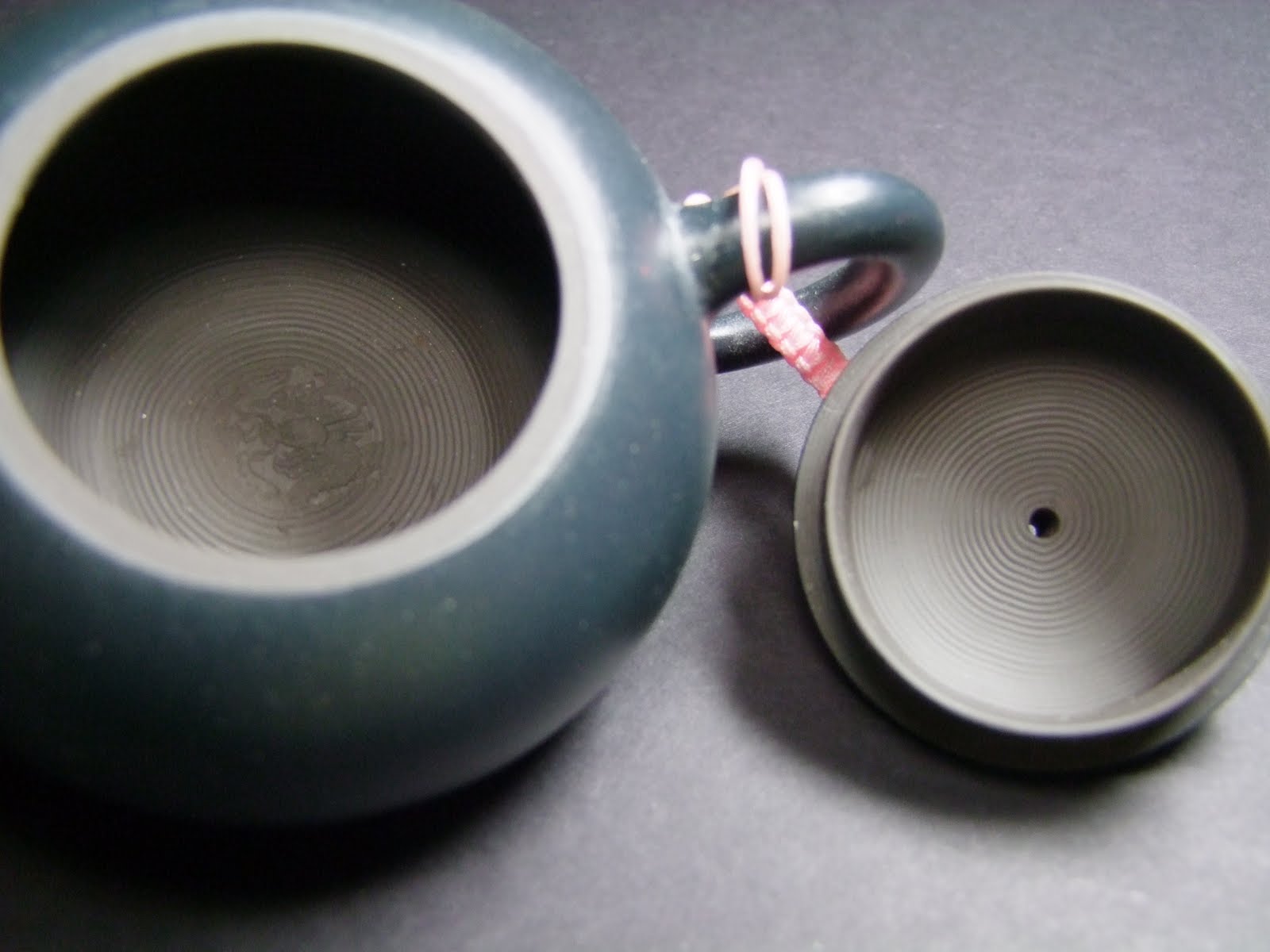
Almost all Chinese teapots (yes, even the very expensive ones) today are made from moulds. Teapot makers make moulds from a teapot and subsequent teapots are made from these moulds. Though you will expect that every production of a teapot production run will be identical in terms of size and shape, there will be small differences when you compare these teapots. This is because there are some hand-work done during the production stage. Spouts and handles are joined by hand. The overall teapot is also hand-finished. You can easily spot this handiwork when you are buying a teapot.....alignment of the handle or spout are some examples. Some teapot makers use a potter's wheel in the production stages, thus the concentric lines on the inside of the lid and teapot (pix 3&4).

I myself have bought a couple of teapots. I did buy a few teapots from Yunnan Sourcing especially the Da Hong Pao range (I will devote a blog entry on this). I have not bought any teapots for investment. I only buy teapots if they catches my eye.....and since I am a little clumsy(broke a couple already).....will not buy the expensive teapots.


Friday, September 3, 2010

Anatomy of a teapot - pt 1


There are 13 anatomical parts found on a chinese teapot. In the book "The Way Of Tea" by Lam Kam Chuen, the parts are handle, stand, bottom, belly, beehive or or inner net, mouth, flow, lip or wall, button, air hole, lid, shoulder and buckle. Click pix 1 for an enlarged and readable view of the parts of a teapot. Its really fascinating. You can now go to a teashop, examine a teapot and than exclaim "I like stroking the belly and bottom of this teapot" and wait for a reaction from the teashop owner. Either he will think you are mad or some sex crazed animal.

The traditional chinese clay teapots are usually made from Yixing clay in China. They come in a myraid of colors. Terms like hong ni(red), duan ni(yellow) or hei ni (black) are used to describe the color of the teapots. In addition, these teapots come in various shapes and sizes. The purple hue Yixing is considered the best quality clay for making a teapot. I would recommend a teapot size of between 120-250 ml if you are brewing tgy, pu erh or oolongs. Try if possible to allocate the use of a single teapot to a type of tea as the aroma of a tea (example tgy) may linger on the teapot for some time even when you have washed the teapot.

In a nutshell on making a clay teapot - clay is mined and extracted, the clay is pulverized into a fine powder, powder is sorted and sieved, powder is washed again and left to settle in a tray of fresh water for some time, water is drained and the clay which has settled at the bottom of tray is dried and later cut to brick sizes. When needed, this clay is mixed with water into a paste and moulded into teapots. Handles and spouts are usually moulded separately before they are attached to the body of the teapot. Teapots are then send for baking (called firing) usually at kilns. Once baked, teapot goes thru final touches before its ready.

If you examine a teapot closely, you can usually observe the teapot's maker seal inscribed at the base of the teapot. You do occasionally see smaller seals on the handle, inside lid and even on the inside of the teapot. The last pix shows additional seals used by the potter.

You will also observe some teapots are glazed while some are not. This glazing, according to my expert teapot collector friends, is more for a visual and aesthetic purpose.

Wednesday, August 25, 2010

2001 Menghai Ripe Cake


This is a 2001 Menghai ripe cake. I had purchased this cake from Amoy Tea (see previous blog). The proprietor had told me that this 2001 Menghai was sold by them to a regular tea collector customer in 2001/2002. This tea collector had kept this tea and have now recently sold back the tea to the shop.

I have never owned any Menghai earlier than 2003 for 2 main reasons; the higher costs associated with old teas and that I am no expert in telling apart the real old Menghai from a fake, which I believe is on the rise due to the high tea prices. Its no surprise that I have broken up this cake for my drinking pleasure.

I noticed that there was no manufacturing date on the wrapper. In addition, the smaller label encased within the case was 'too entrenched' that it broke to tiny pieces when I tried to extricate this label. The compression of this tea cake was quite high and it took quite some time to break up the cake.

This Menghai 2001 ripe cake has a distinct aged raw pu erh tea aroma. I could not exactly pinpoint or fully describe the taste; it seem to have cereal and a chinese herbal aroma as well as a hint of a cooked rice flavour. It also has a mild scent something like an old leather bound book which I actually enjoyed. I found this tea to be an extremely smooth and pleasant drink. I used a shade less tea leaves for brewing as it was very strong during the 1st 3 infusions. Can easily make 10 good brews.

I can tell that the previous owner of this tea kept and stored the tea well as there was no foreign smells and scents (like smoke, cooking smells, detergent).

How does this tea compare to my current stash of ripe pu erh (cakes on average 2-5 years old)? It is obvious that every ripe cake will have its own taste characteristics and even those cakes will the same recipe but different production years will taste different as well. This 2001 Menghai cake has that unique aged raw aroma. The other 2000 ripe brick I opened (and finished -13 Nov 09 blog) has a red dates (the fruit) aroma with a sweetish sensation. I will be going to Penang soon to visit a tea friend and pick up an old Menghai cake which I had purchased. I look forward to its unique aroma and taste.

As I write this blog, the YOG (Youth Olympics Games) held in Singapore will be ending this week. I enjoyed watching the many sports events and I am sure many of these athletes will be stars in the future.... like good pu erh tea.

Saturday, August 21, 2010

Amoy Tea - A Treasure Find


This teashop is in Singapore. Amoy Tea Pte Ltd is located at 331 Joo Chiat Road. This 'treasure find' of a teashop which I would describe as 'frozen in time' is must visit tea shop for Chinese tea drinkers when you are in Singapore.

When Singapore is described to the world, people especially the locals would know the rapid modernization of Singapore over a short span of 40+ years. Today, Singapore boast of a world class financial centre and considered one of the most globalised nation of the world. Yet Amoy Tea appeared that it had not change its facade much for 30-40+ years. It is located in a 1960s' pre war shop house in east coast of Singapore. You will see many new modern eateries where you can eat in air conditioned comfort and choose from a myraid of cooking styles from vietnamese, western and different Chinese culture and dialect traditional cooking. Yet you will observe from the pix that Amoy tea had maintained that 70's aura within the premises.

Amoy Tea is run by the Tans, a uncle and nephew enterprise. Selling only traditional Chinese tea, you can get to buy a bag of liu bao, tgy, a tin of white tea, oolongs, loong ching, pu erh and many other teas. They do sell tea accessories like teapots and gaiwans. I would like to highlight that this shop only takes cash payment. There is also no tea sampling of their teas as the nephew, Mr Tan Yen Kwang explained there are manpower and space constraints, that Amoy Tea is unable to offer tea sampling. You do get to drink a cup of their house tea when you are in their shop.

I bought a couple of ripe pu erh tea when I was there. See my next blog. For those who intend to visit the shop (close on Sundays), it is near the junction of east coast road, between Marshall Lane and Koon Seng Road. Don't forget to try the world famous laksa (coconut curried noodles) when you are in that vicinity.

RELOCATION NOTICE - Amoy Tea has relocated.  They are now at Block 45 Sims Drive #01-164.

Monday, August 9, 2010

My $100 order of tea from Yunnan Sourcing


My 3 kg box of tea arrived from China a couple of days ago. I had ordered some ripe tea from Yunnan Sourcing over the weekend and the box arrived at my door 5 days later.

This order comprised of all ripe pu erh. You will have observed that there are 3 identical 2007 Fuhai ripe cakes (see 2nd May blog) in this order. I am extremely impressed with this cake and this this my 2nd reorder of this cake. The rest of the cakes are (middle from left) 07 Feng Qing, 08 Yong Pin Hao, (lowest row from left) 06 Haiwan, 07 Haiwan 7588 and a 08 Fuhai ripe. I had the box air freighted by ems which took up a fair bit of the expenses.

It is interesting that the 07 Haiwan 7588 is a 250g brick and its length is almost as wide as a regular size pu erh cake (see last pix, click to enlarge). I would think the compression of this brick is fairly light and the tea can be broken up by hand.

Yunnan Sourcing is operated by the proprietor Scott Wilson. He is an American and operates his tea business from Kunming, China. He is fluent in spoken mandarin. I met him last year in Kunming and was extremely impressed with his Chinese as he sounded like a local there.

The tea offered by Scott is very impressive. His website
http://www.yunnansourcing.com/store/
will seem like a candy store to tea drinkers and collectors. I find his prices of tea reasonable. He purchases his tea from authorized tea dealers so you can be assured of no fakes. I find his service to be good and his emails prompt and courteous. His packing is good as evidenced by the above pix. In addition, Scott will try to locate those tea a customer may wish to buy thats not on his site.

I would not hesitate to recommend Yunnan Sourcing as a reliable source for your tea needs. I hope to visit him again when I make another trip to Kunming.......hopefully soon.