Monday, February 21, 2011

The Ancient Art Of Tea


The Ancient Art Of Tea - Written by Warren Peltier from Tuttle Publishing. Printed this year and its already available at the public libraries here.

This book attempts to translate some of the chinese texts and writings on chinese tea and as the author puts it "More Specifically, this book demonstrates the variety of tea brewing skills in ancient times. Much of this knowledge can be directly applied and used in tea preparation today........I hope these translations, many of which have never been translated into English, provide clear insight into Chinese tea culture and help to foster a deeper appreciation of tea."

The author did a a wonderful job in the translations (I myself acknowledge that such translations are difficult as sometimes the meaning or thoughts can be lost in the translation process). Look at pix 2 (click for enlarged views) and you can appreciate that during the olden times, the preparation, tasting and the etiquette of tea can be quite complex. Very interesting reading.

An excerpt from Hu Zai's "Three Don't Pours"
"1. Tea non-new, spring water non-sweet, utensils unclean: first don't pour
2. Foul weather. ugly scenery: second don't pour
3. Uncultured, rude guest: third don't pour."

This book also comes with a few colored illustrations and overall makes a very interesting read for me. Price listed on cover is US$15.95.

Thursday, February 10, 2011

Rose Tea


The general description of the above pictures would be 'rose tea'. I suppose, since there is an infusion process in the brewing method, using the word 'tea' would be more logical and commercially acceptable than 'rose drink or essence'. I myself use the general 'rose tea' label even though there is no single tea leaf used throughout the brewing process.

You will noticed by now only unopened dried rosebuds are used for rose tea. I had purchased this rose tea from Guangzhou, China last December. The rose tea, which I had purchased was imported from Iran, which I was told, produced the best rose tea.

The scent of these dried rose buds was very pleasant. Brewing the rose tea was also pretty simple; just use about 6-8 buds in a 150-200ml vessel, pour hot water and your tea is ready in about a minute. The aroma of the infused rose tea was like a subtle floral perfume. My daughter thought we had fresh flowers in the house when I brewed a pot of this tea.

I found the taste of the rose tea to be subtly sweet. It was a pleasant surprise that there was a creamy finish to the tea. Very light and refreshing. The color of the tea is light yellow. I could also managed a 2nd infusion of the rose tea but found the taste weak.

But I digress - Add one rosebud in your next ripe pu erh brew and you get a very mild floral hint to your pu erh brew. Quite nice actually. Haiwan Tea Co. had sold a production of mini ripe pu erh tuos that incorporated rose tea in the tea some years ago.


Saturday, February 5, 2011

2004 Yunnan Ripe Brick


This is a 2004 pu erh ripe 250g brick. I had purchased this brick from Lau Yu Fat tea shop, Hong Kong (see my previous blog).

The pu erh range sold at Lau Yu Fat tea shop was very good. I could sample any of the tea cakes that was displayed for sale. I chose to sample 2 ripe pu erh bricks from 2003 and 2004. I was fortunate and extremely privileged that the proprietor Mr Lau did the brewing of the tea for me.

Mr Lau skills in tea brewing was silky and fast. As I had previously mentioned, Mr Lau used 3 flash rinse for the brewing of the tea. Sorry I did not have the camera with me at that time. Mr Lau held a kettle of boiling water in his left hand while his right hand managed the gaiwan for the tea rinse. The coordination of the hand movement was like 'art in motion' ; skillful, graceful and artistic. In no time the teacups are filled with tea for my sampling.

The gaiwan used during the tea sampling was about 120-130ml and about 7g of tea leaves was used. My estimation of the weight of the tea leaves was visual. I had been practicing visual estimation of the weight of my tea leaves every time before I have a brewing session. I would then checked whether my estimation was correct by weighing the tea leaves on a electronic scale.

The taste of this 2004 ripe brick was very good. The aroma had a combination of chinese herbs with a good earthly and toasty sensation. It was like drinking a chinese herbal soup that underwent long hours of cooking. Nice color. This tea makes a smooth drink and the aftertaste was very pleasant.

I normally use about 7g of tea and brew it in my 150ml teapot. I could not quite achieve the taste sensations of this tea that I had sampled in Hong Kong. I had to increase the amount of tea leaves by an additional 1-1.5g of tea to achieve the stronger aroma and taste. The additional amount of tea (1-1.5g), which I recommend that you increase, sounds minuscule, but in my case it is a 15-20% increase in tea leaves used. This is a substantial increase. I had also noted that, during my brewing sessions at home, this tea tend to weakened by the 8th drinking infusion. This was fine with me as I usually stop my drinking session at this point.

I had paid about HK$140 for a brick of this tea. The taste and aroma of this tea is, to me, very good. I, however, had to use more leaves for this tea, than what I would normally use for ripe tea, to achieve my preferred brew.

I am happy I had purchased 4 bricks of this tea home ........ I had already used up almost half a brick.

Wednesday, February 2, 2011

Happy Chinese New Year


Chinese New Year falls on 3 Feb 2011.  This is the main event that is observed by the Chinese around the world.  Many Chinese families will have the traditional Chinese New Year's eve dinner and many Chinese will find their way home for this meal even if they are overseas or work far away from home.  Its a common sight to see transport hubs in China overflowing with people a week before and after the Chinese New Year (nicknamed the great migration).  

Chinese have their own version of the horoscope.  They have the animal zodiac where 12 animals take turns yearly to be the zodiac animal of that year.  Tomorrow starts the year of the rabbit.  

You can observe the 'red' or gold paper packets in the 1st pix has a stylized rabbit on the cover.  These packets were issued by the famous Swedish furniture store, Ikea, which was given to customers of their store.  I will be filling my red packets with money to give my grandparents, parents, my kids as well as my younger nephews and nieces.  Oranges symbolizing gold are given to elders when I visit them.  Good food usually follows during such visits.  

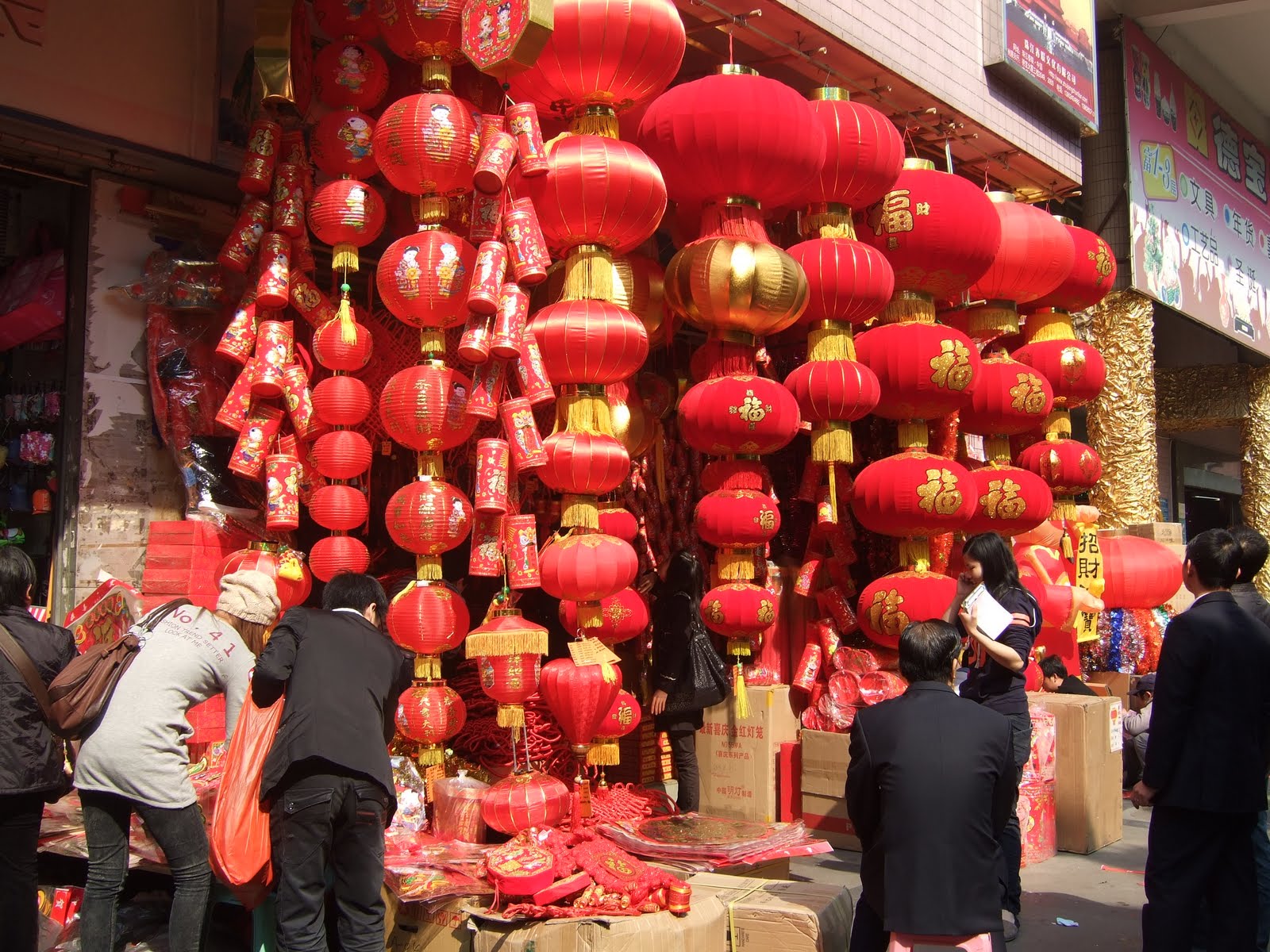
Pix 2 & 3 shows the various chinese lanterns and firecrackers (fake ones) that were sold in Guangzhou leading to the Chinese New Year.  There were literally hundreds of wholesalers selling these festive decorations when I was there.  It was really a colorful sight.

As a Chinese celebrating Chinese New Year, I wish all my readers "Happiness and Good Health".


Friday, January 28, 2011

Hong Kong - Lau Yu Fat Tea Shop


Going to Hong Kong from Guangzhou was easy.  We took the express train from Guangzhou East Railway station all the way to Hung Hom station, Kowloon.  The train stations at both ends are also subway stations as well.  It is advisable to book your tickets at least one day in advance.  Its about RMB 170 per ticket (allocated seats).  It takes about 2 hours for this trip.  I recommend taking the train to Hong Kong as taking the bus tend to be more arduous.  Going by air would also incur you additional transport costs and time to travel from Hong Kong airport to the city.

Hung Hom train station is already in the city and getting around from this station is very convenient. I normally stay in the Kowloon area, specifically the Jordan vicinity and its only about a 10 min taxi ride to the hotel (HK$25).  I love hotels around in Jordan; good and cheap eats, night markets, shopping and walking distance to a subway.  A hotel stay in Jordan would be around HK$700-1200.  Check for internet offers.  

I had the opportunity to visit  Lau Yu Fat tea shop in Hong Kong.  Take the subway to Lok Fu, come out through exit A, turn left and you are in a shopping centre.  Take the escalator one level up and you can locate the tea shop next to a supermarket.

Lau Yu Fat tea shop is a father-son establishment.  They carry a wide variety of Chinese tea and a good range of pu erh.  You can sample the tea and I had the privilege to have the senior Mr Lau brewing tea for me.   Good news is that the shop takes credit cards ( I think online order as well) and since it was my last day in Hong Kong .......  I ended up buying 4 bricks of ripe pu erh (2004), a ripe cake (2008) and the latest issue of pu erh tea magazine. 

I will delve more on Mr Lau's pu erh tea brewing style in later blogs but I observed that Mr Lau practised 3 flash-rinse during my pu erh sampling.  He explained that this 3 flash- rinse will wash, hydrate and awaken the tea.  "Awakening the tea" concept is practised by some pu erh tea enthusiasts as they believe that the pu erh tea would produced its best aroma and flavor with this practice.  My Penang tea expert friend 'awaken his tea' by putting his uncovered pu erh brick/cake in a tin canister for a week before he breaks up the tea for brewing.  As for me, I break open a tea cake/brick and place the tea pieces in a cardboard tea box and only start brewing the tea after a couple of days.  Does 'awaken the tea' (known as xin cha in mandarin) enhance the pu erh brew?  Let me know your thoughts.  

I recommend a visit to Lau Yu Fat tea shop.  Mr Lau and his staff are very friendly and knowledgeable.   Nicolas Tang, a respected tea expert from Hong Kong, in his website www.nicolastang.com rated Lau Yu Fat tea shop very highly in terms of trustworthiness, quality of tea and pricing.  

I enjoyed my time at this tea shop very much and look forward to my next visit. 

Thursday, January 20, 2011

2006 Mengku 'old tree' ripe cake 400g


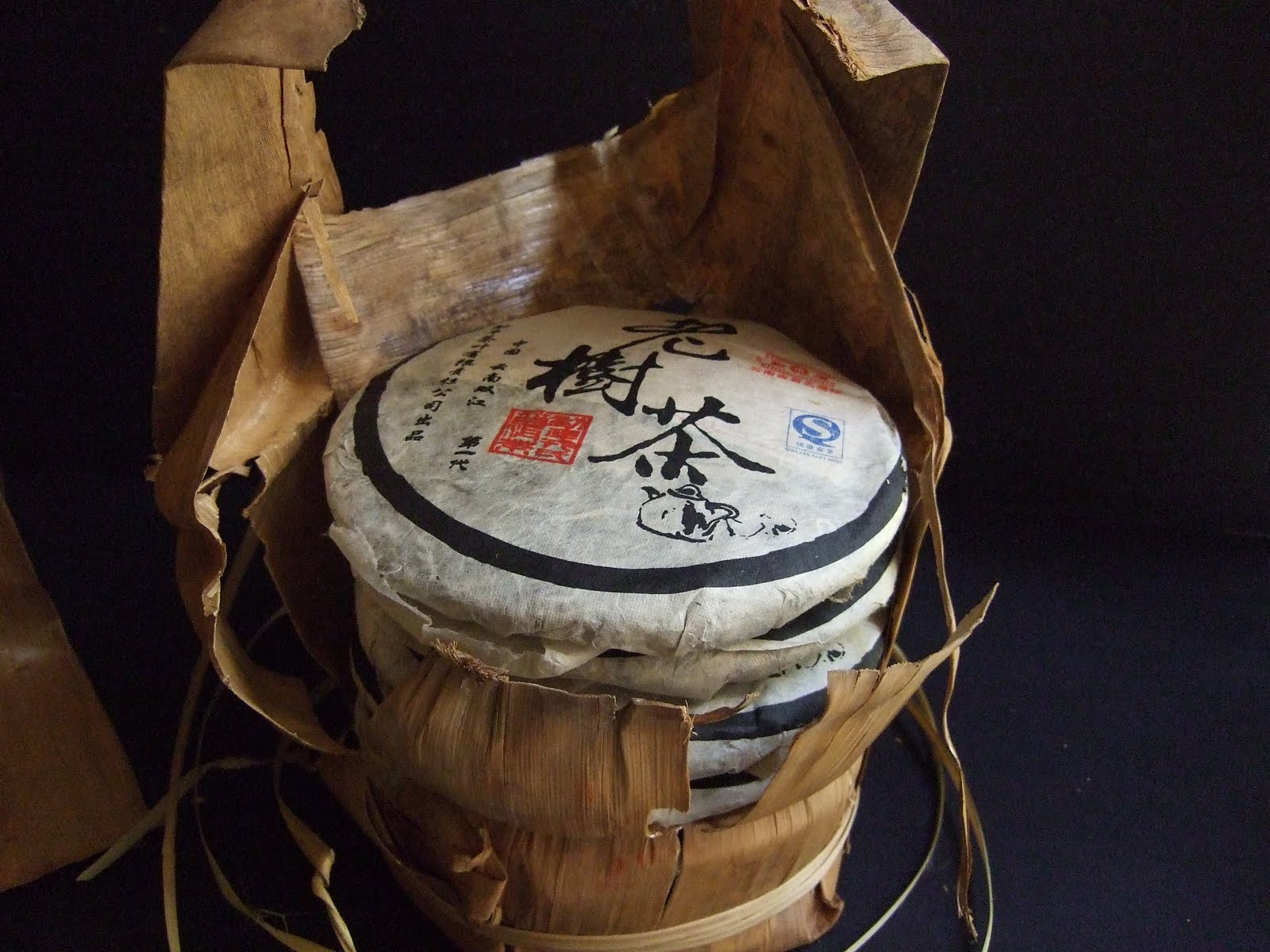
This is a 2006 Mengku 'old tree' ripe pu erh tea cake 400g. I had purchased this pu erh during my last visit to Guangzhou. A tea dealer friend there was packing his tea storage room,installing some new shelves, after 4 years in the tea business. That was when he discovered that he had one unopened carton of this 2006 Mengku ripe tea. He had remarked that this was one of his earliest purchase when he started his tea business. He wanted to keep 2 tongs himself and sell the remaining 6 tongs. He tore opened a tong and did a sampling test on one of the tea cakes. My decision to purchase this tea was easy after sampling the tea.

Notice from the pix(click for enlarged views) how the tea cakes are packed and wrapped; 7 cakes in one tong, with natural bamboo wrappers. The bamboo wrapper appears brittle when I opened a tong of tea. Even the cords binding the tongs are also bamboo cords. You can even see faint red chop marks on each tong (translated as 'old tree ripe cake'). There was a green sticker found on the inner label (called the neifei) that has '2005' printed on it.

Brewing this pu erh was enjoyable. The wodui, associated with newly produced ripe pu erh was no longer present. The aroma was warm and toasty, woody and fragrant. Subtly sweet. The color of the tea was pleasing to the eye. This is a straight forward tea that ripe pu erh drinkers will appreciate.

Why did I buy 6 tongs of this tea? 2 reasons. Firstly, I like this tea. I felt it was a good ripe tea; to drink now and hopefully it will get even better with a few years of storage. Secondly, the price offered to me was good. Price was inexpensive, per cake basis, when I compare with some of the new 2010 ripe pu erh cake offerings by the more well known pu erh tea manufacturers. A few tea dealers there have noticed that more people are buying new pu erh and new tea drinkers and collectors are indirectly pushing up the prices of the popular brands of pu erh. I personally believe that about 40-50% of the new pu erh (raw and ripe) produced are purchased and stored away and are not consumed (at least for a couple of years).

Whenever I have the opportunity to travel, I would try to buy tea especially in China and Hong Kong. Buying chinese tea in Singapore is more expensive and the choices here pretty limited. Moreover, the many varieties and options buying from especially China gives me substantial savings in terms of price and postage (if I ordered online).

Any readers (residing or coming to Singapore) reading this can email me to share this tea loot with me - 2 tongs only.

Friday, January 7, 2011

Fangcun - a revisit


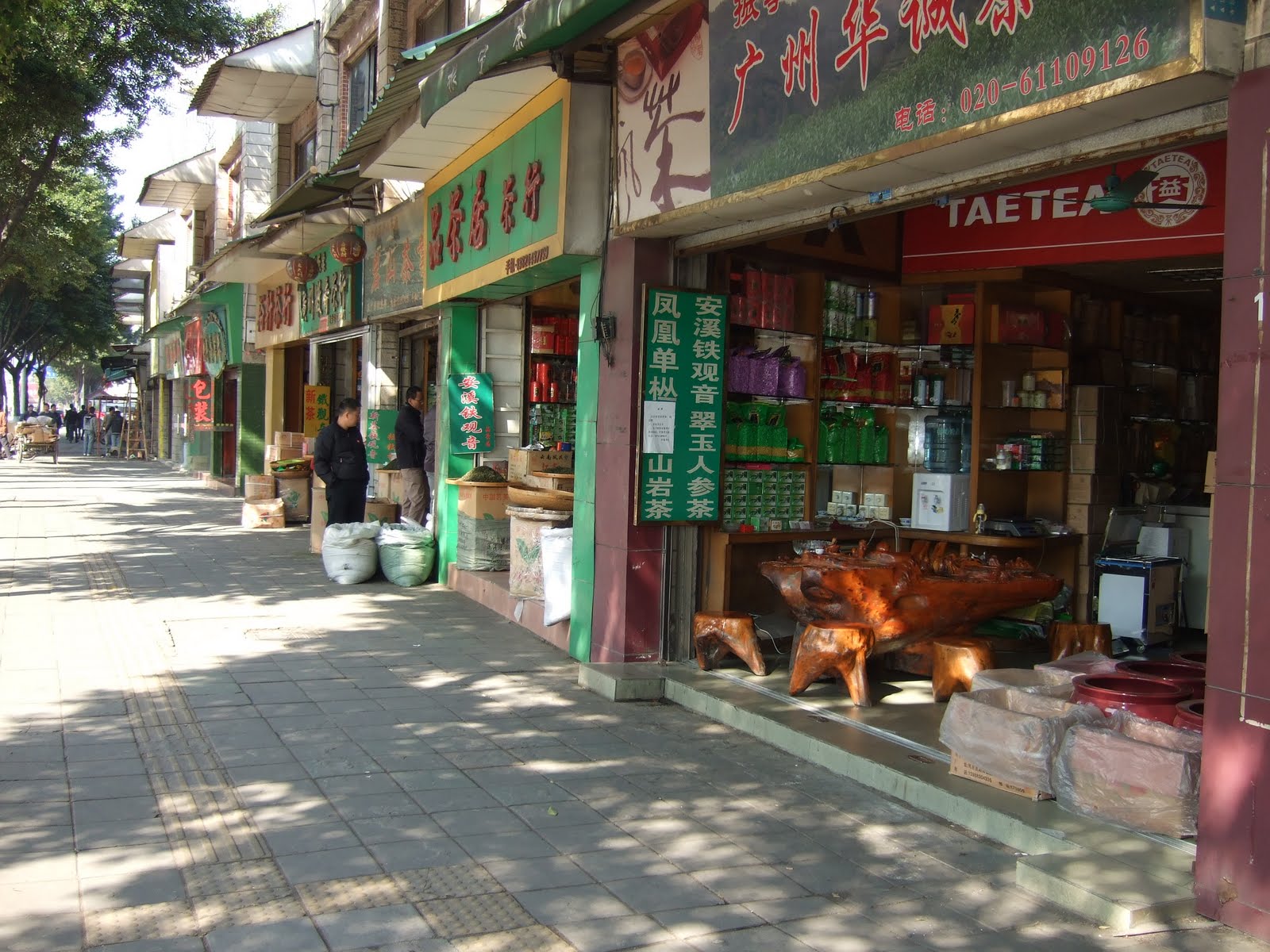
If you are into Chinese Tea and you happen to be in Guangzhou, it is essential you make a visit to Fangcun tea wholesale centre. You will get to see more than 2000 tea merchants selling all things tea and the amount and variety of tea and tea accessories sold there will make any tea drinker enthusiast go gaga for a very long time.

As usual, we had dim sum every morning at the chinese restaurants around the hotel. A dim sum meal with a choice of chinese tea costs US$20 for 6 of us. A dim sum breakfast can be quite filling in that we only get hungry again at around 2-3pm. My kids were pretty fascinated by the piglet red bean buns and made a couple of reorders to fulfilled their amusement.

Well anyway, you can easily get to Fangcun by subway. Its clean, convenient and fast. We used the subway every time we travel in Guangzhou......even the express train station from Guangzhou to Hong Kong (Guangzhou East station) has a subway stop at the basement. One word of advice; it gets extremely crowded on Sundays. As Sunday is a rest day, the trains get very packed. Be prepared to get shoved and pushed on Sunday. I have been on many subway trains in Japan, Korea, Hong Kong, London, Paris, Taipei, Bangkok and Singapore and I can say that the level of 'pushing and shoving' here on Sunday can be pretty intensive. I reasoned the capacity level of the trains were exceeded on these peak hour weekends. Weekday subway rides were however very comfortable.

Back to tea. Fangcun is the place to go for Chinese tea in Guangzhou. I would like to stress again.....you must know your tea you are buying. Be aware of the relative prices and always sample the tea before a purchase. Mostly cash sales even you are buying 50000rmb of stuff.

One of the bigger tea complexes there housed a commemorative giant pu erh cake. Weighs a ton I think. The room even had a guard to prevent people like me taking this cake home as a souvenir.

There were also shops that sells dried floral and fruit infused tea. There were rose buds, dried citrus orange slices and many other wonderful smelling stuff which I could not identify. I bought a bag of dried Iranian rose buds and another bag of unopened chrysanthemum buds.