Sunday, July 17, 2011

Glow Dayi Glow


Our Malaysian tea celebrity, Auhckw, bought an UV lamp and shone the light over his Menghai Dayi collection. Pix courtesy of auhckw; who had generously consented to share his findings with us.  The 1st 2 pix are '2010 pu erh while the 3rd pix is a '07.  The last 4 pix are '07, '08, '09 and '11 Dayi pu erh.  

This security sticker is a big deal for the Dayi tea collector.  There are, sadly, a high number of fake pu erh teas that are sold in the tea markets.  This is compounded that a majority of the fakes are Dayi brand of pu erh.  I myself, look at the security sticker, when I buy Dayi tea.  For me, I will examine the silver strips on the sticker and look out for the Chinese "大益" on the silver strip as a guide when I buy the tea.

Dayi in order to protect the customers from buying fakes decided a few years ago to affix security stickers.  Dayi, informed their dealers and customers the various features of these stickers like the silver strips, die-cut stickers and the stickers having glowing characteristics under a UV light.

So, are we to conclude, if the Dayi sticker does not glow.....its fake?  I do not know the answer.  Maybe I might write to Dayi for a clarification.

I would like to thank Auhckw for this interesting finding.  He had indicated that he will shed more light on this controversy soon.

One thing for sure, sales of UV lamps will surge a little.  You will see strange lights coming out from the Dayi tea collector's home in the next few weeks.  Glow Dayi Glow.

Friday, July 8, 2011

Qiu Xiang Tea (M) Sdn Bhd


Qiu Xiang Tea (M) Sdn Bhd. has 4 tea branches in Malaysia; 3 in KL city and one in Klang. This was one of the tea shops that auhckw had recommended to me to visit during my visit to KL last month.

Readers would be familar with 'Auhckw'. Yes, he is the famous contributor of Chinese Tea information on the internet. He is prolific in his contribution on Chinese Tea. He takes lots of pictures and shares much information about Chinese Tea and on the tea market in Malaysia. He impressed me as very thoughtful and generous. A new good tea friend.

I had stayed in the Chinatown district during my stay in KL as I enjoyed browsing through the daily night market there. At the night market, I could have a piping plate of fried noodles, select and buy from a wide choice of fresh local fruits, purchase a bag of freshly roasted chestnuts, shop for 'luxury' bags and watches all on one street. And.....in the day, just a street away, there is a cluster of Chinese teashops that made me grin from ear to ear.

Qiu Xiang has an outlet on Jalan Sultan. I was there late morning, and a Ms Chen was manning the shop. This tea shop was well organized with a good range of pu erh tea. They even have their house 'pu erh' as seen in pix 4 & 5 (they have quite a good range of house pu erh).

Ms Chen provided a tea sampling session of their house tea. The video showed Ms Chen brewing their house brand '08 ripe pu erh (pix 5). I noticed 2 things about the tea session. The water used was always at boiling point (which I approve). I also observed that the infusion time was quite long.....10 seconds +. She has used about 6-7 g in her gaiwan. She explained that this tea tasted best with a longer infusion time unlike the other ripe teas in the shop. This tea was very good.

I left Qiu Xiang happily with 3 cakes of tea.

Saturday, July 2, 2011

2011 Malaysian Tea Art & Cultural Expo


I went to Kuala Lumpur (KL) last week. I would like to take this opportunity to thank my new tea friend, Mr Chua, who uses the nick 'auhckw' in international tea forums. Many tea collectors and enthusiasts would be familiar with 'auhckw' as he is prolific in his posting of news and pictures of the Chinese Tea market in Malaysia. I am grateful that 'auhckw' has been generous in sharing his tea knowledge and makes every effort posting pictures of tea, teapots and other Chinese tea related materials almost on a daily basis especially on teachat.com.

I had introduced myself to auhckw early last month and had communicated with him on the internet seeking his expert advice on Chinese Tea. He was very friendly and was able to answer all my queries on tea. He had also mentioned that there was a Malaysian tea expo, held yearly, that would be on in July. He suggest that I attend the expo and even give me pointers on which teashops to visit while in KL. He even offered to accompany me to his fav teashop in one of the afternoons (see later blogs). That week was a quiet week and my wife was on vacation. We were in KL before we knew it.

The 2011 Malaysian Tea Art & Cultural Expo was held in Tropicana City Mall. We just took the train and then switch to a complimentary shuttle bus to the mall. The ride there was a breeze.

This blog entry is picture intensive and would give you an inkling of the Tea Expo. You must click the pictures for clearer and enlarged views.

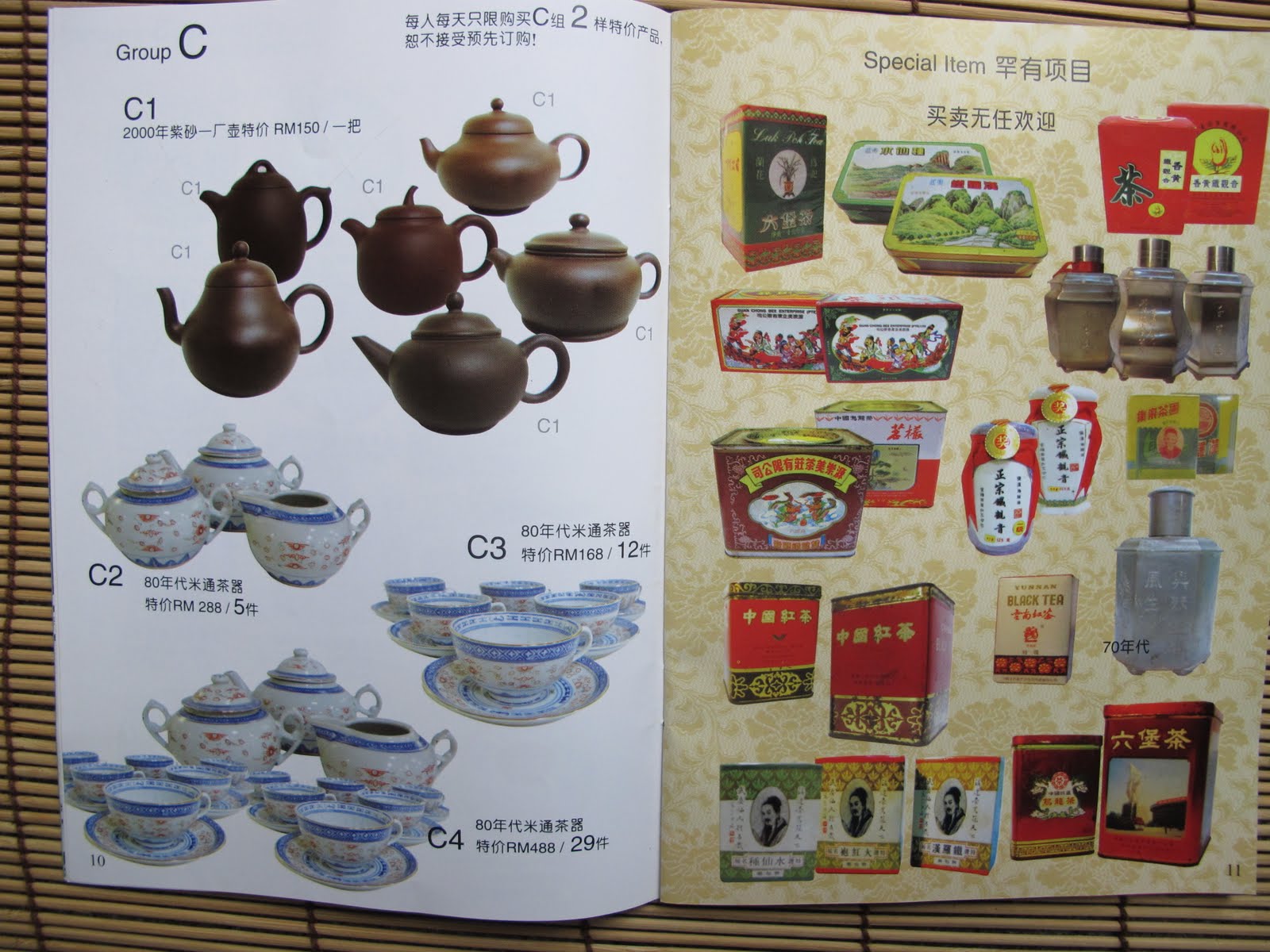
The 1st four pix is a brochure given to visitors of the tea expo. As a treat to visitors, they are allowed to purchase (supposedly at special prices) one item each from Group A, B, and C. Auhckw instructed me to get the Menghai cakes in red tin (2nd pix, lower left). This is the 2011 ripe pu erh. The tin consists of 5 cakes each 150g per cake. Pix 4 shows an ad taken out by one of the exhibitors there. This exhibitor was a teashop specializing in Liu Bao Tea. I purchased some of this aged tea at one of the booths.

Visiting the individual booths was interesting. You could sample some of the teas on offer and buy the tea or teaware at special prices. I bought 2 stainless steel tea caddies while moving around the booths (pix 5 & 6).

Pix 7 is the teapot that was the main highlight on the cover of the tea expo brochures and posters. Auhckw mentioned that its made from Yixing clay, enamelled and painted on the outside. Qing dynasty period.

Pix 8 & 9 was an interesting stop for me at the tea expo. You can buy 200g of raw pu - you choose from different types or grades from the large jars, pay for it and have your tea compressed manually into a cake. Pix 9 shows an assistant standing on a stone press compressing a tea cake. You can even personalize the tea wrapper for your tea cake.

The tea expo was well organized. As it was held in a shopping mall, visitors like me can easily have a meal at one of the many restaurants or fast food joints there. My wife and I had the luxury to do some shopping at the mall before calling it a day. Very enjoyable.


Thursday, June 30, 2011

A flawed design teapot


If you have been reading my blog entries, I tend to be positive with my thoughts and findings on the topic of tea. I had recently returned from Malaysia last week after attending the tea expo there and had brought back some tea (slightly more than 3 kg).

One of the tea purchased was some aged Liu Bao. Liu Bao tea is fermented black tea originating from Guangxi province. It has many similar characteristics of ripe pu erh and there are stories of unscrupulous tea dealers passing off Liu bao tea as expensive ripe pu erh.

Anyway, I had purchased this teapot locally. You can observe from the pix (click pix for enlarged view) that its a nice teapot. The design and color of the teapot is pleasing to the eye and I had no hesitation paying for this 500ml+ teapot.

The design flaw of the teapot became painfully obvious when I brewed some of my precious Liu Bao in this teapot. The mouth of the spout is higher than the lip of the teapot (see blog sept 2, 2010, anatomy of a teapot). As a result, when I tip the teapot to pour out the tea, some tea will spill out from the lip. I tried to slow down the pour but it was quite a futile excercise. Now you know why, you should not buy teapots of such designs.

My wife is happily using this teapot for her plants. Nuff said.

Saturday, June 18, 2011

The Tea Box


My daughter, Ashley gave me a father's day present.

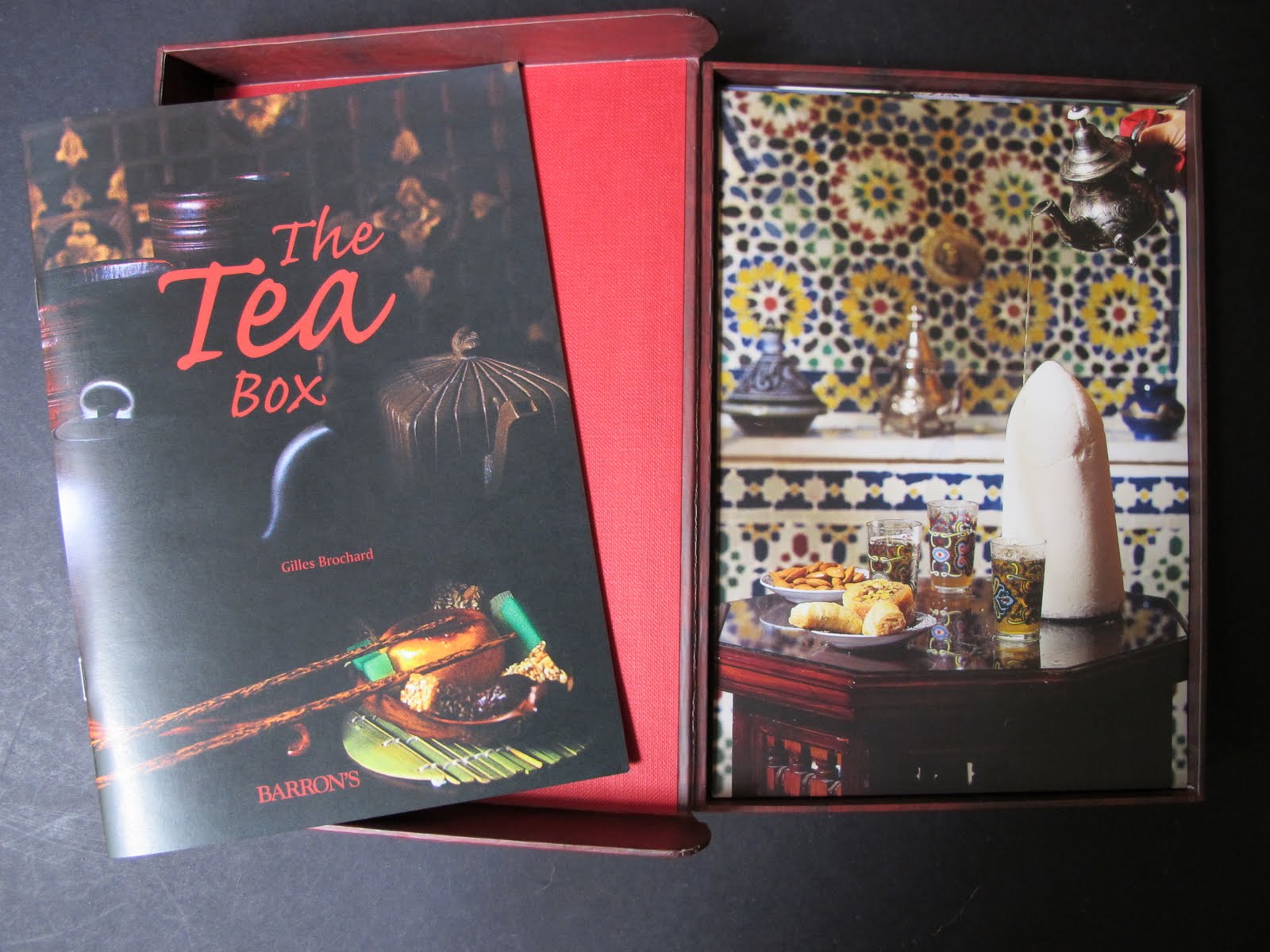
This is 'The Tea Box' written by Giles Brochard. Published by Barron in 2001, this cardboard presentation box contains a 32 page booklet and a 40 A5 size cards. The tea booklet introduces the advent of tea in China, Japan and Europe. This booklet delves on the history on tea and some stories behind the tea. Its an interesting read. The 40 cards are well taken photographs of tea which include more information on tea as well as tea recipes like using tea as pastries and in cooking.

Pix 2 shows the inside of the opened box while pix 3 are photos of the tea cards. The top card in pix 3, is the 'green tea coconut pearls' while pix 4 shows the reverse of the card detailing the recipe to make these pearls. The last pix is a page capture of the tea booklet.

A nice father's day gift.


Friday, June 10, 2011

Kee Heung Chun Tea Co.


Kee Heung Chun Tea Co. is located at 30A Belcher's Street, Hong Kong. It is located in the Kennedy Town district. It takes less than 15 min by taxi if you start from Tsim Sha Shui.

This tea company is owned by and run by the Lam family (since 1938), now into its 3rd generation. Mr Parker Lam and his wife, as seen in the pix represents the second generation and their son Derek Lam is the current managing director of this tea company.

I visited this tea shop in late April this year and had the privilege of both Mr & Mrs Parker Lam showing me their shop and having a tea sampling session that afternoon.

A couple of things to note when you view the pix (click for enlarged views) - Mrs Lam used her favorite side handle teapot when she brewed pu erh. I have rarely seen such teapots and in action as well. More importantly, note in pix 3 the clear water canister on the right of Mrs Lam. It is common that in Hong Kong, drinking water is usually dispensed from bottled water and the water is usually distilled water. The Lams 'mineralised' the water by putting mineral stones in the water jug and having the water in the jug for at least a couple of hours. These stones, I was informed, are hand selected from the remote river systems in Mongolia. I have heard of such 'mineralising' stones and its a fascination seeing it in use. Ahem - I bought a large packet of these stones. More on these stones in my later blogs.

Kee Heung Chun Tea Co. has a very wide assortment of teas available for sale and there is no pressure to buy after the tea sampling sessions. However, I would like to recommend their supreme TGY (pix 5). It is the traditional, robust, full aroma and flavor tgy. For traditional roasted tgy, I am extremely impressed with the quality and will make repeat purchases of this tea when I am in Hong Kong. Maybe the teapot in pix 4 as well. Anyway Mr Lam informed me that their supreme tgy is normally re-roasted by Mr Lam himself in the tea shop when new shipments arrived, so as to ensure the super taste and aroma standards of this tea.

Worth a visit.


Friday, June 3, 2011

2004 Xiaguan Ripe 357g


I purchased this tong of pu erh during my December trip last year. This is the 2004 Xiaguan ripe pu erh 357g.

I normally do not purchase old pu erh (below 2004) during my trips to Guangzhou. I am not experienced in old pu erh and I am not familiar with the pricing of such tea. Moreover, my tea dealer friends mainly deal in new teas as these dealers are in the business of supplying new and current teas to tea shops and tea enthusiasts within mainland China. My tea dealer friends tell me that the sales turnover for new teas is faster. Yes, they have the odds and ends of current tea that is not sold but these dealers I know are not interested to sell old pu erh as they think that the sales for such tea is slower and older teas are hard to come by.

During my last Dec trip, one of the tea dealers there had kept aside one tong of the 2004 Xiaguan ripe for me. He explained that one of his important customers had requested for some old Xiaguan ripes and this dealer managed to wrangle a few such tongs from one Xiaguan wholesaler in Guangzhou. I was told that this particular Xiaguan cake was 'hard to find' in the tea market which explained the higher price I paid.

You will notice from the above pix that the tong is tied with metal wires. Beware - these wires may be rusty and untying the wires bare-handed can be quite hazardous.

There are no markings on the reverse wrapper of the tea cake as well as an absence of manufacturing dates on the wrapper. There is also no neifei (an enclosed note), which I normally see in pu erh cakes that normally describes the benefits of pu erh.

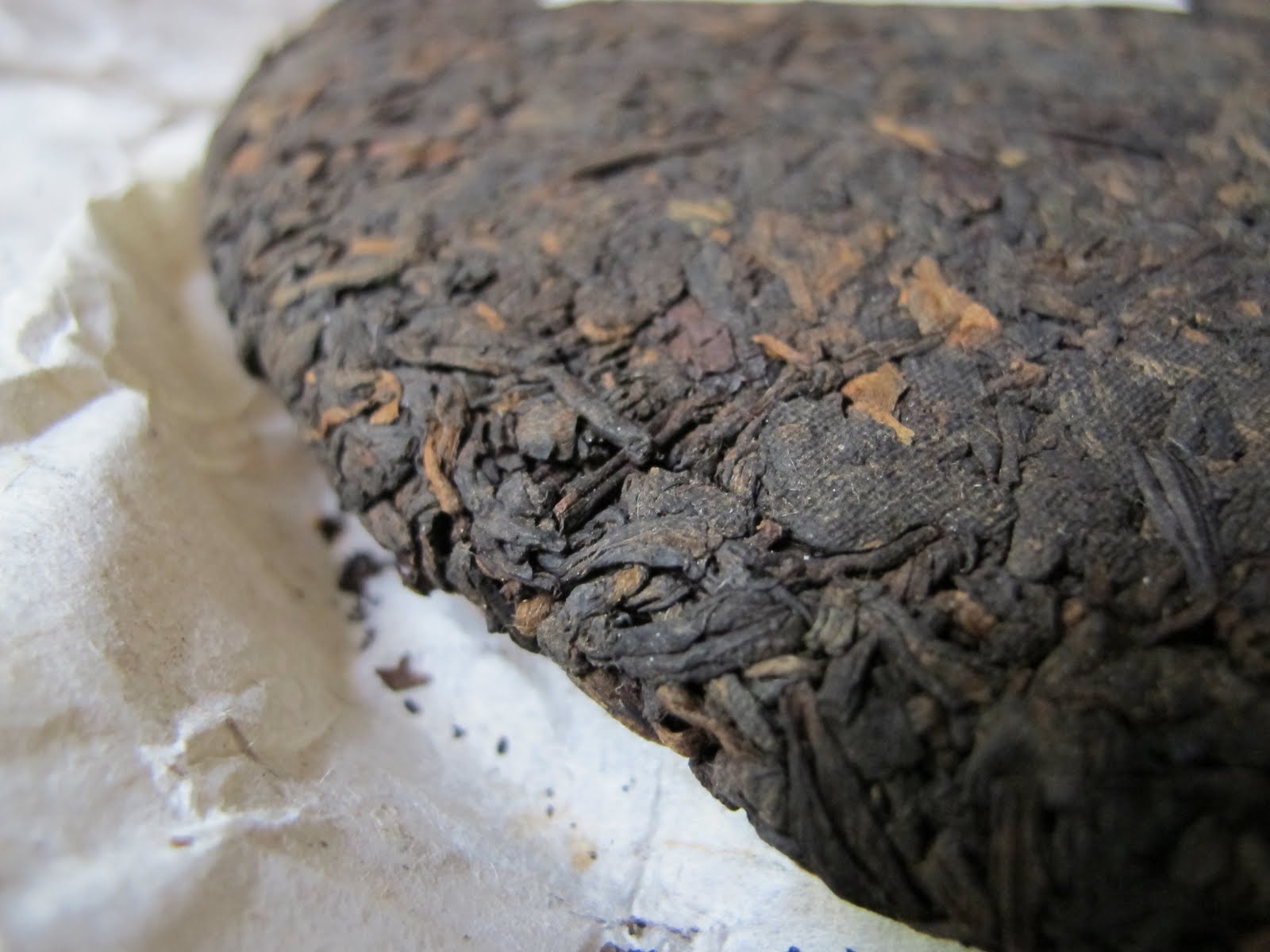
This Xiaguan ripe cake is bigger than the normal cakes in my collection. This 'not too tight' compression allow me to break open the cake without using any tools; just literally use my hands to break up the cake. I think that this level of compression is good as I do not get too much tea fanning or tea dust as compared to breaking up a tightly compressed tea cake.

The aromatic levels of this cake when I brew this tea is very impressive. The aroma is pleasantly strong with hints of chinese herbs and a oak-like scent. Together with a nice sweet finish, this tea puts a tiny smile on my face.