Friday, November 4, 2011

The "Lau Yu Fat teapot"


I was in Hong Kong in May this year and grabbed the opportunity to visit Lau Yu Fat teashop and bought some stuff. ( also see blog entry 28 Jan 2011)

This teapot is designed and sold exclusively by Lau Yu Fat teashop. The 180 ml capacity teapot was recommended to me by Mr Lau (teashop owned and run by father and son) senior. He explained that the rinsing of pu erh tea should be fast, so that you would not waste the tea from prolonged rinsing. He had designed a teapot that allows for a quick pour-out of tea. The 1st 2 pix are that of the teapot I took while I was at their teashop while the last 3 pix belong to the teapot I had purchased. Click pix for larger views.

This teapot has 22 drain holes. This is significantly higher than the average 7-9 holes you find in most teapots. I did a quick comparison with my current teapot (180c) I am using, and this 22-hole teapot was slightly faster in the pour-out race. I did not time that race but for those regular teapot users, I felt that faster time was only like an odd second or two faster. Was there a taste difference in brewing the tea..........For me.....no. I normally adjust my brewing times in accordance to the teapot as well as the tea. Moreover, I am a little clumsy with my teapots; already broke a couple the past 2 years.......and I find that I had to understand my new replacement teapots and adjust the brewing of tea accordingly. Some pu erh teas I am drinking may need a few more infusing seconds before I pour out the tea. But I would like to qualify that this teapot may be quite suitable for those teas that brews fast and strong.

The price of the "Lau Yu Fat teapot" is now going at HK$800 at the teashop. For the tea drinker who have a chance to visit Hong Kong, this teapot does merit a purchase consideration.

Tuesday, October 25, 2011

Asian Geographic - coffee and tea edition


I was filling up my car at at a petrol/gas station when I saw this magazine at the newsstand. This was the coffee and tea edition (issue84) of the Asia Geographic. It costs $7.50.

This particular magazine issue focussed on coffee and tea. The pictures were really nice and the articles made good reading, for me at least.

Below is an excerpt from an article about tea as a miracle cure:

"Antioxidants are a little more complicated to understand, but its these chemicals that get the modern medical profession excited. When a substance oxidises it can produce free radicals - atoms.molecules or ions with unpaired electrons that are highly reactive. Free radicals start chain reactions that can damage cells, causing or accelerating degenerative diseases from cancer to coronary heart disease,to Alzheimer's and Parkinson's. Antioxidants, which occur naturally in tea (in particular, green and white tea) terminate these chain reactions by removing the free radicals and inhibiting oxidisation.

.......A 2005 study at UCLA's Jonsson Cancer Center showed that green tea interrupted the spread of bladder cancer.........that green tea interrupted the signalling pathways involved in actin remodelling, instead trigerring cells to bind togerther and remain localised rather than spreading to other parts of the body.

Modern life assaults the body from all sides: pollution, infections, stress and even sunlight take their toll. Put away the dietary supplements, self-help books and punishing lifestyle regimes and go back to one of life's simplest pleasures; drinking a cup of tea. There's never been a better time to put the kettle on. "

The articles made an interesting reading and the photo illustrations accompanying the text were very vivid and beautiful. I enjoyed the coffee article (last pix) on making Malaysian coffee; where the beans are roasted over a charcoal fire, and the coffee is usually drank sweetened with condensed milk. Its a real satisfying beverage and I look forward to visiting Malaysia in the Christmas week later this year,

But I digress - I noticed, I suppose its inevitable, that coffee is considered the beverage of choice in many cities like Singapore. I remember that, not too long ago, coffee machines was a bubbly percolater, where you add a cone-shaped paper filter to the machine, add beans and water to make a brew. Now, the coffee machines......wow, like some futuristic star trek equipment, where you can have combinations of coffee brews with just a press of a button. The coffee machine even takes pride of place in a home. My friend recently called me "come over and have coffee, just bought a &^%# brand coffee machine. The machine was beautiful and mind boggling. The way the coffee is brewed and dispensed seem like some magic or hocus pocus wizardry. Impressive. Its now difficult to ask back my friend "come over for chinese puerh, check out my new gaiwan". To anyone who is reading this and contemplating doing a tea machine......please, get it done quick, I will queue in line for it.

Let me end this blog entry with another excerpt from the magazine:

"Nobody denies the beneficial healing properties of tea, not as medicine as such, but rather a daily ritual, an excuse for a much needed break, a social lubricant. Drink in that spirit, and health, happiness and eternal life will follow."

Saturday, October 15, 2011

2005 LangHe Ripe Pu erh 357g


This 2005 Langhe ripe cake was purchased locally in SIngapore. Yunnan Sourcing gave a description of Langhe ripe pu erh as "Langhe tea factory has been producing teas for more than 15 years. A Menghai based tea factory that specializes in producing Pu-erh tea in the traditional manner. Langhe ripe pu-erhs are special because their fermentation process is "lighter" using less heat and shorter times. The result is a brewed leaf with a slightly greenish-brown appearance. This lighter fermentation process allows for a more gradual transformation into a ripe tea. Langhe ripe teas typically take 2 to 3 years to lose their "dui wei" and become very enjoyable to drink."

Maybe its the light fermentation, but I found that this tea is very forgiving in that its difficult to over-infuse the pu erh. My experience with ripe pu is that most of the pu brews fast and strong and leaving the hot boiling water in your teapot or gaiwan may result in an extremely strong cup of tea. This situation occurs when I exceed 5 -8 seconds for the 2-4 infusions especially when brewing loose gong ting leaves and Dayi ripe tea and lao cha tou. Side note - the color of the brewed tea leaves looked uniformly brown - I suppose its due to the hot humid weather of Singapore and that this tea was stored here for 5 years.

I found the aroma of the 2005 Langhe to be that of cooked rice. There were also hints of toasted bread. Sweet finish. However, I detected a subtle hint of vegetal, something like a green tea finish, when I drink this tea. Its not unpleasant and I do recommend for ripe pu erh tea drinkers - do purchase a Langhe ripe cake in your next tea purchase.

Saturday, October 8, 2011

Straits Chinese Porcelain Teacups Pt.2


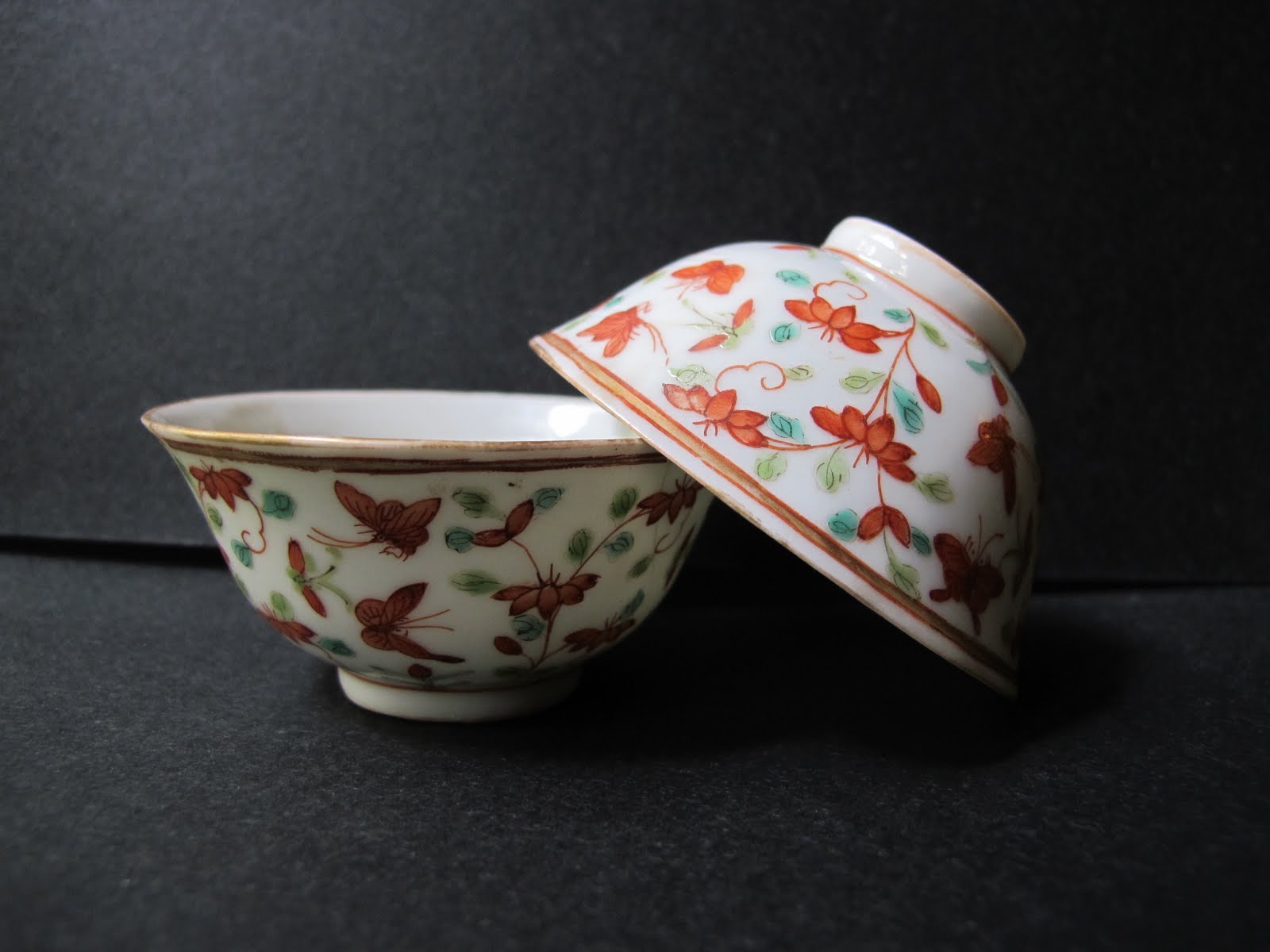
There were some readers that wanted more information on Straits Chinese porcelain teacups after my blog entry on 7 Aug 2009. Straits Chinese Porcelain were used in by the Peranakan community in the the earlier half of the 20th century. Most of the porcelain were specially produced for this community in Jingdezhen China.

There were however, porcelain made in Japan, that was used by the Straits Chinese as well. The top 3 pix are Japanese made teacups that are classified as Straits Chinese Porcelain. In my limited handling of Straits Chinese Porcelain, I felt that the Japanese made teacups were more refined in the finish. Some collectors do not recognize such porcelain as Straits Chinese but discoveries of such porcelain in old Straits Chinese homes could not be disputed. Such Japan made porcelain I had seen, had white as the background whereas the China made ones may come in a myraid of colors like white, green, pink, yellow, brown, blue and coral red.

The last pix is an unusual China-made nonyaware (straits chinese) teacup. The coral red color is considered a rare color in the nonyaware range of porcelain.

Saturday, October 1, 2011

Earl Grey - New vs Old


Alan Watkins wrote a very thought provoking tea article, on 29 Aug 2011 in the Daily Mail. Text and picture from the following website: (http://www.dailymail.co.uk/news/article-2030922/Earl-Grey-drinkers-dismiss-new-recipe-affront-tea.html)

We're pining for our old Twinings: Furious Earl Grey drinkers dismiss new recipe as 'an affront to tea


It is the company credited with transforming tea into the nation’s favourite tipple more than 300 years ago.

But now Twinings has provoked the ultimate storm in a teacup by tampering with one of its best-known and most cherished blends.

Fans of the company’s Earl Grey tea are furious that the firm has altered the traditional flavouring and relaunched it as The Earl Grey.

Trouble brewing: The original Earl Grey which customers say they want back

They say the new product tastes like ‘lemon cleaning product’ and describe it as ‘dishwater’ served up in a cup.

Dozens of angry tea drinkers have posted complaints about the new flavour on the company’s website since the new brand was launched in April.

One wrote: ‘I cannot describe how awful this new tea tastes. The old award-winning tea was in a completely different league to this foul-tasting dishwater.’

Others have simply described the new product as ‘horrid’, ‘vile’ and ‘an affront to tea’.

One wrote: ‘I agree with the other posts here that the new Earl Grey is an awful disappointment!

‘Bring back the old recipe that was refreshing and flavoursome.’

Some tea drinkers are so dismayed by the new blend they have added their names to a Facebook campaign called ‘Bring Back the Original Twinings Earl Grey Tea’.

Several have enquired on the campaign page where you can find old stock of the original Twinings Earl Grey on supermarket shelves.

Twinings, which was founded by Thomas Twining after he opened a tea room on the Strand in London in 1706, is generally acknowledged to have been the first company to sell the first brand of Earl Grey tea.

It launched the blend in 1831, naming it after the Prime Minister of the day, Charles Grey. The distinctive taste is created by infusing black tea with the oil of the bergamot orange from South-East Asia.

Though Twinings was first to market Earl Grey, its origins have been disputed for nearly 200 years.

According to one story, the blend was first created by accident when a gift of tea and bergamot oranges was made to Earl Grey from diplomats in China and the tea absorbed the flavour of the oranges during its journey by sea from Asia.

Others say Earl Grey was gifted the recipe for the blend by a visiting Chinese dignitary.

Twinings’ new The Earl Grey contains extra bergamot and citrus.

According to the company’s website the product has been ‘refreshed’ with an ‘additional hint of bergamot’.

Alex Probyn, a master tea blender who runs the firm Blends for Friends, said: ‘You are talking about changing a product that people have been drinking for decades. A reaction is inevitable.’

A spokesman for Twinings insisted it had carried out extensive market research before implementing the changes.

He said: ‘As with all changes to blends, our new Earl Grey has undergone rigorous consumer tasting, receiving strong preference feedback over the previous blend.’

Saturday, September 24, 2011

2006 Hong Tai Chang Ripe Pu erh Cake


I recently opened a 2006 Hong Tai Chang cake. This 400g ripe cake was purchased locally in Singapore and the Hong Tai Chang has a very pleasant unique ripe pu erh taste and aroma that is the signature of the tea company.

My first encounter with Hong Tai Chang was a 2005 ripe cake in 2009 (see 27 Nov '09 blog entry). I enjoyed this tea very much and I do see this brand being sold on the internet and teashops worldwide. For your information, if you happen to be in Hong Kong, do pop by the Yue Hwa Chinese Emporium, go to the top floor and there is a whole floor of tea and tea products for sale there (go basement for the tinned oolongs). You can sample a few Hong Tai Chang tea there and buy a cake or two. I was there in Jan this year and the prices for this cake was less than US$25.

The aroma and taste of this tea.......I like. It has hints of camphor, slightly minty with a nice herbal aroma. It has a mild sweet aftertaste as well. Please, if possible, sample this tea before you buy as your taste preferences could be different from mine. I have a tea friend who is indifferent to this tea, and would buy other ripe cakes instead. However, to me, this 400g Hong Tai Chang cake is one yummy tea.


Sunday, September 18, 2011

The Lady Tasting Tea


“It was a summer afternoon in Cambridge, England in the late 1920s. A group of university dons, their wives, and some guests were sitting around and outdoor table for afternoon tea. One of the women was insisting that tea tasted different depending upon whether the tea was poured into the milk or whether the milk was poured into the tea. The scientific minds among the men scoffed at this as sheer nonsense. What could be the difference? They could not conceive of any difference in the chemistry of the mixtures that could exist. A thin, short man, with thick glasses and a Vandyke beard beginning to turn gray, pounced on the problem.

“Let us test the proposition” he said excitedly. He began to outline an experiment in which the lady insisted there was a difference would be presented with a sequence of cups of tea, in some of which the milk had been poured into the tea and in others of which the tea had been poured into the milk.”

This were the opening lines to chapter 1 of the book “The Lady Tasting Tea”. Published by Holt paperbacks, 2001, this book explained the birth and evolution of the use of statistics in science. And, tea, was an indirect participant, in one of the earliest use of statistics in a scientific finding. Even though statistics itself is boring, the author, David Salsburg, made this book highly readable and entertaining. A fun and informative read. Below are a couple more excerpts from the book:

“…..The man with the Vandyke beard was Ronald Aylmer Fischer, who was in his late thirties at the time. He would later be knighted Sir Ronald Fischer. In 1935, he wrote a book entitled The design of Experiments, and he described the experiment of the lady tasting tea in the second chapter of that book. In his book, Fischer discusses the lady and her belief as a hypothetical problem. He considers the various ways in which an experiment might be designed to determine if she could tell the difference. The problem in designing the experiment is that, if she is given a single cup of tea, she has a 50 percent chance of guessing correctly which infusion was served, even if she cannot tell the difference. If she is given two cups of tea, she might guess correctly. In fact, if she knew that the two cups of tea were each made with a different infusion, one guess could be completely right (or completely wrong).

…….In his book, Fischer discusses the various possible outcomes of such an experiment. He describes how to decide how many cups should be presented and in what order and how much to tell the lady about the order of presentations. He works out the probability of different outcomes, depending upon whether the lady is or is not correct

……And the lady tasting tea, what happened to her ? Fischer does not describe the outcome of the experiment that sunny summer afternoon in Cambridge.. But Professor Smith told me that the lady identified every single one of the cups correctly."