I purchased a few of these 2004 Xiaguan Te Ji tuos during my recent trip to Kunming. I had heard that the Xiaguan Te Ji in box was better than the ones in wrapper (5 tuos in a wrapper). I have the wrapper version as well (link) even though there were from 2007 instead.
I think I may have overpaid for these 2004 tuos at 80rmb each in Kunming but this was the only occasion where I had came across these 10 year old tuos and I succumbed to buying half a dozen of these tuos.
This 100g tuo is smoky. It exudes a nice dry sandalwood scent when brewed. I could detect a faint floral aroma with a tiny sweet after taste. Quite a nice tea, in my opinion.
As this tea had been stored in Kunming, making comparisons with some of my tea stash that has been stored in Singapore would imply any conclusions are unbalanced and unfair. I felt that pu erh tea stored in Kunming, seem to be more delicate in taste and aroma. Perhaps the lower humidity there could be one of the reasons.
A very enjoyable tea but I hesitate to recommend a 'buy' of this 2004 tea. You will have recalled that I had also purchased in Kunming, the 2013 Xiaguan 100g bricks (link) that had 5 year old raw pu erh blended into the production. This is way much cheaper. Both are very good teas, but the 2103 Xiaguan brick, in my personal opinion, would give more bang for your buck.
But I digress. I received a mail which the writer suggest I seem to like the big production teas like Xiaguan, Dayi or Haiwan. Yes, I do like them and writing about them does allow my readers to make notes or compare their views on the teas which they may also own or have intentions to buy. Writing on the more obscure brands, I think, may just read like a fiction book. I would like to add that I had bad experiences with these big brands as well. One of them was a 2003 Jia Ji boxed raw tuo 100g, which I had kept for almost 5 years. The tea was flat, almost tasteless. There are also some old raw teas that has the 'sabun' (malay word) or soap aroma which my Malaysian tea friends enjoy , that is found in the first few infusions of some big brand raw pu erh tea. I am really trying to appreciate this aroma....really. With so many teas in the market, it will be hit and miss for everyone..... tea drinker, tea shop and tea producer included.
Yes, I am aware that the Chinese mid autumn is about a month's time away and that's when we are suppose to eat moon cakes. But..... I love moon cakes and they are already available in the stores. In fact, this box of moon cakes were from Hong Kong.
The pu erh tea cake in the pix was from Hong Kong too. It is produced by Fuhai tea factory and was a generous gift from Hong Kong's most famous tea blogger, Marshaln whom I met early this year.
Life as a tea drinker is good. Moon cakes and great tea. Now which teapot should I use?

The following article appeared in the Irish Examiner , 26 July 2014, and is well written by Dan Buckley. (link) entitled "What shape of tea bag should you buy for a better brew?"
It was a question that might have puzzled the Sphinx, but the answer lies in a simple pyramid.
Due to a storm in a teacup, the question of whether a pyramid-shaped tea bag or a round tea bag brews the best cup of tea has finally been answered — by the British Advertising Standards Authority of all people.
The makers of Tetley tea bags are probably wishing they’d had a nice hot cuppa instead of indulging in a mug’s game over claims that a rival product tasted better than theirs.
Tetley pitted its round tea bags against the pyramid bags of PG Tips in a complaint to the UK’s Advertising Standards Authority over a television advert.
Irish tea lovers need not worry: Tea-makers here enjoy more friendly rivalry and are not planning any such competition, with Barry’s sticking to its square bags and Lyons favouring its pyramid-shaped bags.
Tetley said the PG Tips ad, which showed the difference in ‘brewing power’ between a pyramid and a round tea bag, was exaggerated and misleading to viewers.
The ad features comedian Johnny Vegas and a puppet monkey sitting at a kitchen table, demonstrating that pyramid bags are better at releasing flavour than round ones — a claim Tetley said was untrue.
The comedian says in the commercial: “Monkey, you know how you always say: ‘There’s no other tea to beat PG’... What if you’re lying? Like when you said there was an angry owl in the biscuit cupboard?”
The monkey then makes two glass mugs of tea — one with a pyramid bag and one with a round bag. A close-up shows how the pyramid bag begins colouring the hot water, starting the brewing process quicker.
The monkey says: “PG Tips uses pyramid bags, so if we test one against a regular tea bag you’ll see the tea has got more room to move, freeing the great fresh taste for a perfect cuppa.”
Tetley challenged the claim that the PG Tips tea was superior as it had more room to move in the pyramids, thus “freeing the great fresh taste”.
Science won out and, supporting the PG Tips claim, the advertising authority ruled that the pyramid tea bag — invented in 1997 by Brooke Bond, the then parent company of PG Tips — did in fact have better brewing efficiency.
The authority said: “Unilever provided test results which showed that the infusion of tea, at 40 seconds and two minutes into brewing, was greater when using a pyramid tea bag than when using a round tea bag.
“We therefore concluded that the advert did not exaggerate the capability and performance of the advertised product and was not misleading.”
A spokeswoman for Tetley said the decision related only to the speed of infusion which was not “a key factor in determining the quality of a cup of tea”.
“Tetley’s extensive research shows that the round tea bags, combined with high-quality tea, are just as effective as other shaped tea bags. Ultimately, the shape of the tea bag is not as important as the quality and taste of the tea.”
The rivalry here between Barry’s and Lyons is more friendly, with neither tea maker throwing shapes or having a go at the other.
Nevertheless, Lyons said it has statistics to show its pyramid bags help to enhance flavour but pointed out that its bags are not the same as PG Tips, although both firms are owned by Unilever.
“The Lyons pyramid tea bag allows the tea leaves more room to move, infusing the tea with the rich golden hues of the Lyons tea blend more quickly than a standard square or round tea bag,” said a spokeswoman.
“Given that most Irish people [72%] allow their tea bag to brew for less than a minute, this means tea lovers can enjoy a great tasting cuppa more quickly,” she said, adding that the Lyons pyramid tea bag is unique to Ireland and specifically developed for Irish tastes.
For Barry’s — Ireland’s homegrown tea maker — it’s all about the quality of the leaf and the expertise of the blending. “We believe that what goes into the bag is more important than its shape,” a spokeswoman said. “The quality of great tea always comes through, regardless of the shape of the tea bag.
“The talk at the moment seems to be all about the shape as opposed to the tea. And at Barry’s Tea, we believe the quality begins with the leaf. It’s the quality of the leaf, the blend, and the expertise that goes into tea that gives Barry’s Tea its much loved taste and unmistakable quality.”
Need to have a cuppa after all that.
Have a cup
- In Ireland, we drink up to five cups of tea per day — that works out at 300 litres of tea per person every year.
- Tea contains about half the level of caffeine as coffee, so you could drink up to six cups of tea per day and it would still be considered a moderate level of caffeine.
- 72% of Irish people allow their tea bag to brew for less than a minute.
- The number-one selling tea in Ireland is Lyons Tea and it has been in Dublin since 1902.
- All tea comes from the same plant — an evergreen shrub called Camellia sinensis. The only difference is in the way the leaves are processed. If its leaves are not dried quickly after picking, they wilt and oxidise. To control the oxidation process, the leaves are dried at different stages depending on the tea type — green, black or oolong.
- The Irish tea market is worth an estimated €78m.
- Barry’s Tea accounts for 40% of all tea sales in Ireland.
* Facts from the websites of Barry’s Tea and Lyons Tea
© Irish Examiner Ltd. All rights reserved
I am impressed with the pu erh produced by Langhe Tea Factory. The ripe and raw cakes I had drank (see my earlier blogs) were to me, very good and this ripe cake I had opened was not a disappointment either.
This is a 2006 Langhe ripe cake. Unlike wines where names are given to the wines, pu erh cakes are named with a 4 digit number, which in this instance is 9579. Yes, it is quite difficult to remember these numbers especially when these numbers are only used by a specific tea factory, and tracking down such teas may be a challenge when you are in a teashop.
This Langhe 9579 has a nice strong wood and herb scent. I like this tea as it is a nice tea to brew and drink in the evening. Very smooth and has a calming effect after a tea session.
Singapore readers will be happy to know that Amoy tea (relocated to Block 48, Sims Place) has some of this inexpensive tea in their stock.
I bought some Japanese tea ware recently. Some of the tea ware, as you will have noticed from the above pictures, looked appropriate for brewing Chinese teas I am drinking. I had even purchased a few Japanese ceramic water jars with covers which I will use to store my tea (I will have a separate blog entry for these jars).
Why did I buy Japanese tea ware? They are not that expensive (almost my Japanese purchases were made through Ebay). Yes, some of these tea ware are used or old, but I was intrigued by these stuff I had bought. Somehow, there is a less 'commercial' feel to these tea ware......and I wanted to 'test' out how these tea ware would perform in a Chinese tea brewing session.
The 1st set above is called Bizen ware. They are unglazed and looked reddish brown. Bizen ware is believed to contain a higher amount of iron in the clay, and I believe that they may, like my purion teapot enhance the taste of my Chinese tea.
(do look out for my future blogs when I try out Chinese tea brewing on these tea ware). This Bizen set, comes beautifully packed in its own wooden box. The bigger bowl is called a yusamashi, a water bowl which I suspect is used to hold water and added to the 'gaiwan' when brewing Japanese tea. This set is an old used set, and was informed by my seller as being made by Konishi.
The pair of white teacups in the last few pix are straw-ashed glazed teacups. They are newly made and produced by Shibuya Deishi. I liked the look of these cups as the exterior of the teacups resembled the bark of a cherry blossom tree covered by snow exposing 'bits' of the tree bark. My seller says such teaware are classified as Hagi ware.
Time for a cup of tea.
Haiwan Tea Factory in 2006 produced 2 versions of this tea. A 200g and 400g cake was made and released for sale. I had managed to snagged both versions few years ago from Yunnan Sourcing and I believed the proprietor Scott still have a couple more of the 400g cakes for sale.
This tea is non smoky but I found this tea to be very enjoyable. There is salivating sensation after I drank the tea and there was a delayed faint sweet aftertaste. Very smooth tea and a session of this tea ends quite fast.
A little expensive now, but the price is comparable to some new pu erh tea produced these 2 years. This tea is already 8 years old and I do think it gives more value for money.
Happy Independence Day!
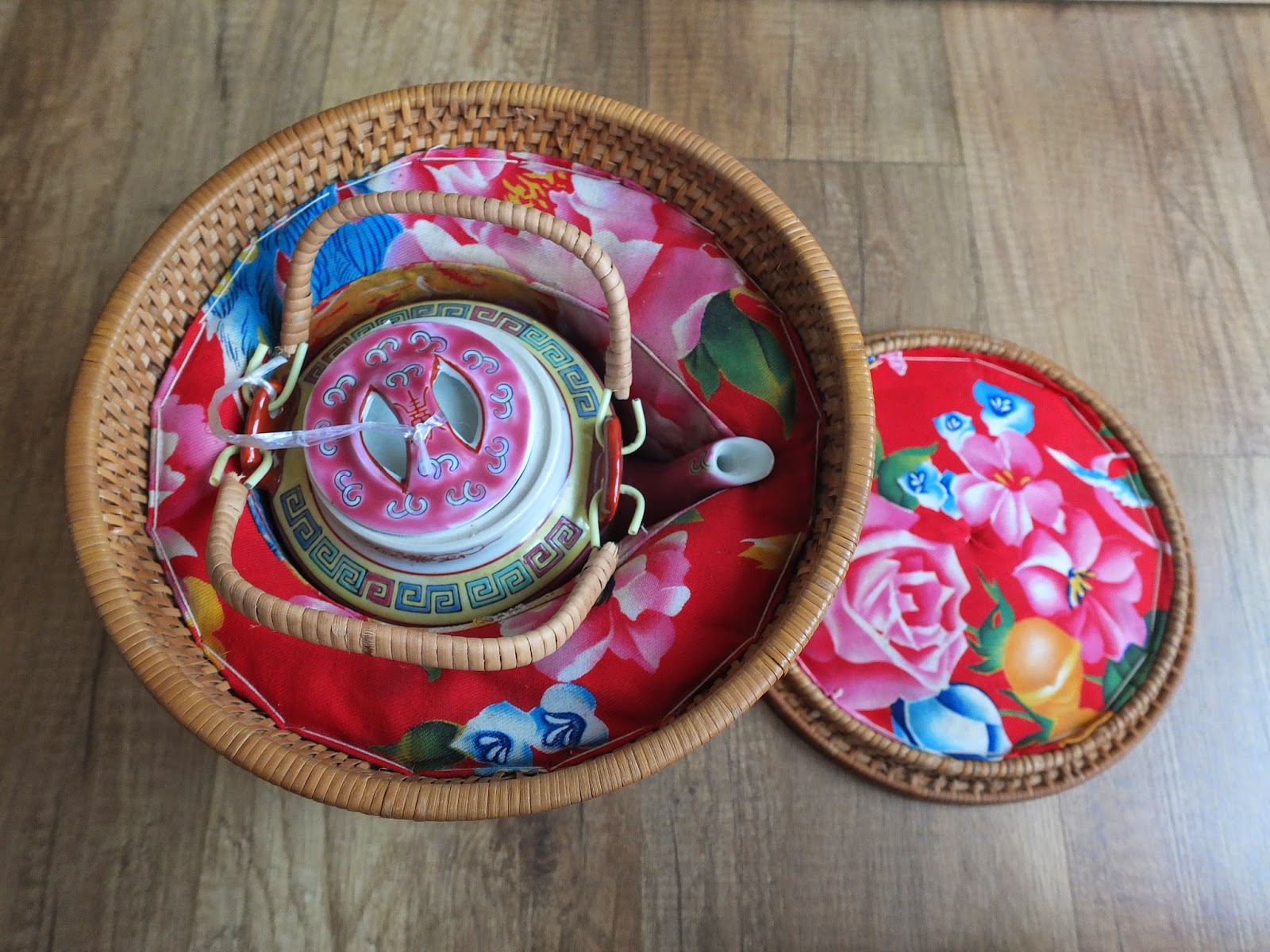
During the 1960s to 80s, one common sight in many homes and offices would be this basket that contain a cylindrical teapot. This tea set basically was designed to keep the tea warm for a few hours. If you noticed the 2nd pix, the interior of the basket is lined with thick foam but is 'wrapped' with a colorful cloth. Such a setup can enable up to 2 liters of tea to be kept warm. My teapot shown is smaller and holds about 1.5 liters instead. I was told that in the older days, a fresh brew was made every morning and another in the afternoon. A tray of teacups are usually located next to this tea basket. In some baskets, there are even space to store a couple of teacups.
I did ask my tea seniors if they remember how tea was brewed in such a set up. "Easy" - I was told. A few tablespoons of tea, and add hot water, and its ready to drink in a few minutes. What tea do they brew? I was told heavy roasted oolongs like TieGuanYin or Shui Hsien. Don't people drink coffee? Yes, mainly black sweetened coffee but its brewed and stored in vacuum flask instead of such a set up.
Brewing tea then was simple. I believe the term 'grandpa tea' is used to describe this brewing method. The tea leaves are perpetually soaked in the teapot and the tea will taste strong after such prolong soaking.