Wednesday, September 4, 2024

2019 Taetea Dayi Raw Tuo


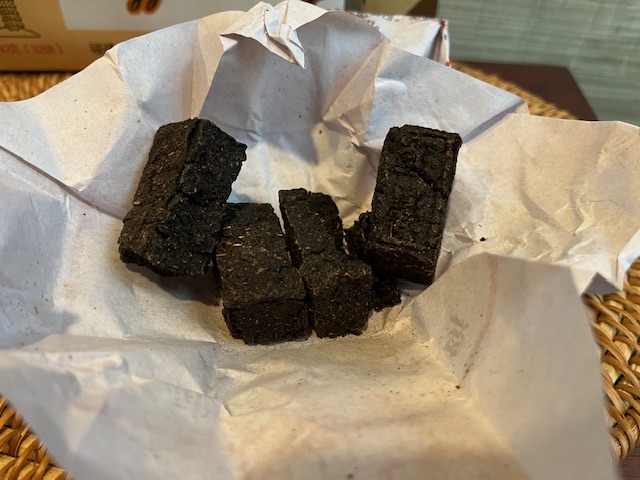
I recently opened a 2109 Taetea Dayi raw tuo.  The tea was moderately compressed and I easily opened the tuo with the help of a tea pick. 

My recent sampling of newer raw pu erh tea was not very exciting as many of the newer raw pu erh tend to be very lightly processed. The new pu erh lack the raw strength in both taste and aroma. There is hardly any bitterness or complication of taste in the tea. Yes, most the new raw pu erh is easy to drink and can be drunk now without the need for long term storage. I suppose this style of processing is to appeal to the newer or younger tea drinkers who want to drink their tea purchases now and are not wanting or have any desire to store their tea for more than 10 years before consuming the tea. 

This Dayi tuo is actually quite pleasant. It is not that 'green' in that I could taste a little of the traditional pu erh processing in this tea. There is light bitterness and a faint sweetness in the aftertaste. 

I prefer my pu erh to be on the stronger side than this greener kind.  Maybe I am too fussy. 

Friday, August 16, 2024

All Things Tea On The Internet


You can buy tea from the internet.  With a few clicks you can purchase your tea and have your tea delivered and even air flown to your doorstep.

You can even glean much info on tea from the internet as well. From blogs like you are reading now and the various social media sites like Instagram. Go to Youtube and you can find two elderly but distinguished gentlemen brewing and commenting about the tea they are drinking. There are also discussion groups where you can find out what tea drinkers are thinking about the tea that they had purchased.  

All seems good.  Except that the main contributors on tea on the internet are the same people for the past few years.  We need you, the reader to contribute your thoughts on tea, your pictures of tea and tea ware, or even tea videos and share them with the tea community. I had written about Chinese tea for more than 10 years and I feel that I should be passing the baton to the next person.  Whatever things I had found out about tea, I share the information gleefully on my blog and Instagram posts. We need a fresh reboot. We need a new James Bond or Princess Leia.  We need you.   

Friday, August 9, 2024

Unravelling Sun Yi Shun Liu An Tea


I had written my thoughts about Liu An tea earlier this May.  I had noticed that the various Liu An baskets I had was different. There were slightly different variations in the packing of the tea in small rattan baskets. Taste and aroma was also different. I had assumed that Sun Yi Shun tea factory simply adjusted their Liu An tea, like adjusting the fermentation levels, to cater to the different demands of the Chinese tea markets.

A little bit of history. Sun Yi Shun factory had closed down for about 40 years before new productions of Liu An tea restarted around 1990s. Many of these newer production tea had the Sun Yi Shun neifei enclosed in the tea baskets.

This was where I got my assumptions wrong. I had talked to a Liu An distributor and I am now better informed about the state of the Liu An production. 

There are about 4-5 tea factories in An Hui, China. These factories have the Sun Yi Shun neifei enclosed in their Liu An tea baskets.  I had identified 2 of these factories and should be able to get the names of the other factories in due course.  

The 1st factory is a Wang Zhen Xiang tea factory. The neifei has a small logo which is an outline of a human face (supposedly the owner, Mr Wang).  The other tea factory is  Lao Liu An tea factory.

This would indicate that the Sun Yi Shun label is not exclusive to any tea factory that produces Liu An tea.  My guess is that the tea factories use this old label to be more creditable and later adding on their tea factory name to distinguish themselves from their competitors.

The Wang Zhen Xiang version is fruity with a slight herbal complexity in the tea. The Lao Liu An version is more sweet scented with a more pronounced sweet dried fruit aroma in the tea. Both tea are excellent. I will put a study pack of both these tea for my readers next week.    

Friday, July 26, 2024

The Shou Pu erh


The Shou pu erh cake in the picture is a 2005 Haiwan ripe pu erh cake.   I started my Chinese tea adventures 20 years ago when I first stepped into a Hong Kong Chinese tea shop.   It was shou or ripe pu erh that caught my imagination. I was simply smitten with the taste and aroma of the tea. 

I believed that it was Hong Kong that Chinese tea drinkers outside China got to know this tea. Hong Kong was the gateway to China 20-30 years ago. People from all over the world would go to Hong Kong to buy and order goods that were made in Mainland China. Hong Kong acted as an intermediary and was successful in this endeavour.  

Hong Kong started introducing kok poh in the 80s (ripe pu erh with added chrysanthemum flowers) in many Chinese eateries and later offering poh lay (ripe pu erh) outright when the Chinese tea drinkers there started to enjoy this tea. The later discovery of the famous 88 Qing (raw pu erh) had made pu erh one of famous Chinese tea today.

I love drinking ripe pu erh tea. It is a calming and very enjoyable tea. With age, ripe puerh is smooth, sweet and mellow.   I was in Hong Kong last month and I enjoyed visiting the traditional dim sum shops (daily) and ordering poh lay tea to accompany my meal. 

Wednesday, July 3, 2024

Wuyi Qing Yuan Cha Bing


I saw this tea at a local emporium.  This is a herbal Chinese tea.   This oolong tea is from the famed Wuyi region. However I suspect that the tea is low grade.  The unique point of this tea is that this is a herbal tea where herbs like liquorice, mint, orange peel, lingzhi, mulberry and other herbs are blended into the tea. 

This tea when brewed taste like a Chinese medicinal herbal tea that are sold by many Chinese medicinal shops in South East Asia. There is bitterness from the herbs and yet....there is a faint sweetness in the aftertaste.  If you enjoy Chinese herbal tea, this tea is as close as you can get without making a trip to a Chinese medicinal shop.   

This box has 8 packets of tea with each packet enclose with 4 mini tea bricks (about 8g each). 

A very unusual tea.  An enjoyable beverage. Imexpensive. 


Friday, June 14, 2024

Tips To A New Pu erh Tea Drinker


I am heartened to received questions from a few new pu erh tea drinkers from Europe and USA this year.  Many had asked about pu erh tea and how I brew my tea. Below are some 'tips' which I had discovered during my tea journey and adventures. Many of my readers would know these techniques I used for pu erh tea...so I apologise to the older readers if these 'tips' are familiar to you. 

1.  Breaking up your tea cake. When you have a new pu erh cake whether you got it from a shop or delivered by mail,  I would recommend (if you want to drink this tea) to break up the tea and place the broken pieces in a tea caddy.  Leave it for at least 2 weeks before you consume the tea. This aroma and taste would be much better if you open the tea cake directly when you had got the tea. This is call 'Xin cha', aka waking up the tea. I cannot explain why this works but breaking up a tea is practised by many serious tea drinkers. 

2.  Brewing the tea. You would normally need about 5-8g of tea when you have a tea brewing session. You can use a porcelain gaiwan or a teapot (approx 100-180ml).  When you use say 7g of pu erh tea. Do not put a 7g chunk of pu erh tea in your tea brewing vessel.  Some of these tea chunks are quite hard and you may still end up with a chunk of tea in your teapot after 5 infusions. Use a small tea pick or your fingers to pry the tea chunk to 6-8 pieces. This would allow the tea to infuse well throughout the tea session.   I recommend you to have about 6-8 infusions of tea from one sitting. If you want to 'rinse' the tea before you start your tea session, fill your gaiwan or teapot with the tea, add hot water to half the gaiwan and quickly discard the tea. 

3. Use boiling water for all your tea infusions. This simple trick will make sure the taste and aroma of tea is fully displayed during your tea session. There are some drinkers I know that only use boiling water for the initial infusions and continued the later infusions with the hot water in the kettle. The hot water will cool quickly and it gets cooled faster during winter. 

4.  I do not recommend you stretch a tea session for an extended time. Let me explain. If you have a tea session say in the morning, you can have 4 infusions in the morning and a few more in the afternoon. I do not recommend you 'continue' your tea session into the next day. It is my opinion that your tea leaves are damp and it may not be optimal or healthy that you overstretch a tea session. One tea drinker friend who drank a lightly roasted high mountain oolong and had accidentally left his tea in a gaiwan for 2 days, was shocked to discover a yellow/orange fungal growth on the leaves. Yes, this may not happen to pu erh tea but we are only examining the tea with our naked eyes. There may be something nasty on the tea leaves.   


Saturday, June 1, 2024

2011 Haiwan Zi Yun Raw Pu erh


When I sampled this tea more than 10 years ago, I liked it so much that I purchased a carton of this tea and followed up with another carton one year later.  

This is the 2011 Haiwan Ziyun raw pu erh brick.  I had also found out that this was a special order by a Guangzhou tea dealer.  This 250g tea brick came packed in a presentation cardboard box. This tea was made from the purple varietal leaves of the pu erh tree and blended with pu erh from the Yiwu region. 

I do not recommend this tea to a new pu erh drinker. There is hardly any sweetness from this tea.   This tea is strong.  Bitter notes dominate this tea with a very complex woody, herbal and floral profile in the tea. I enjoyed the salivating sensation after drinking a cup.   A nice warm kick emerged after a session of this tea.  I like.