I am impressed with the pu erh produced by Langhe Tea Factory. The ripe and raw cakes I had drank (see my earlier blogs) were to me, very good and this ripe cake I had opened was not a disappointment either.
This is a 2006 Langhe ripe cake. Unlike wines where names are given to the wines, pu erh cakes are named with a 4 digit number, which in this instance is 9579. Yes, it is quite difficult to remember these numbers especially when these numbers are only used by a specific tea factory, and tracking down such teas may be a challenge when you are in a teashop.
This Langhe 9579 has a nice strong wood and herb scent. I like this tea as it is a nice tea to brew and drink in the evening. Very smooth and has a calming effect after a tea session.
Singapore readers will be happy to know that Amoy tea (relocated to Block 48, Sims Place) has some of this inexpensive tea in their stock.
I bought some Japanese tea ware recently. Some of the tea ware, as you will have noticed from the above pictures, looked appropriate for brewing Chinese teas I am drinking. I had even purchased a few Japanese ceramic water jars with covers which I will use to store my tea (I will have a separate blog entry for these jars).
Why did I buy Japanese tea ware? They are not that expensive (almost my Japanese purchases were made through Ebay). Yes, some of these tea ware are used or old, but I was intrigued by these stuff I had bought. Somehow, there is a less 'commercial' feel to these tea ware......and I wanted to 'test' out how these tea ware would perform in a Chinese tea brewing session.
The 1st set above is called Bizen ware. They are unglazed and looked reddish brown. Bizen ware is believed to contain a higher amount of iron in the clay, and I believe that they may, like my purion teapot enhance the taste of my Chinese tea.
(do look out for my future blogs when I try out Chinese tea brewing on these tea ware). This Bizen set, comes beautifully packed in its own wooden box. The bigger bowl is called a yusamashi, a water bowl which I suspect is used to hold water and added to the 'gaiwan' when brewing Japanese tea. This set is an old used set, and was informed by my seller as being made by Konishi.
The pair of white teacups in the last few pix are straw-ashed glazed teacups. They are newly made and produced by Shibuya Deishi. I liked the look of these cups as the exterior of the teacups resembled the bark of a cherry blossom tree covered by snow exposing 'bits' of the tree bark. My seller says such teaware are classified as Hagi ware.
Time for a cup of tea.
Haiwan Tea Factory in 2006 produced 2 versions of this tea. A 200g and 400g cake was made and released for sale. I had managed to snagged both versions few years ago from Yunnan Sourcing and I believed the proprietor Scott still have a couple more of the 400g cakes for sale.
This tea is non smoky but I found this tea to be very enjoyable. There is salivating sensation after I drank the tea and there was a delayed faint sweet aftertaste. Very smooth tea and a session of this tea ends quite fast.
A little expensive now, but the price is comparable to some new pu erh tea produced these 2 years. This tea is already 8 years old and I do think it gives more value for money.
Happy Independence Day!
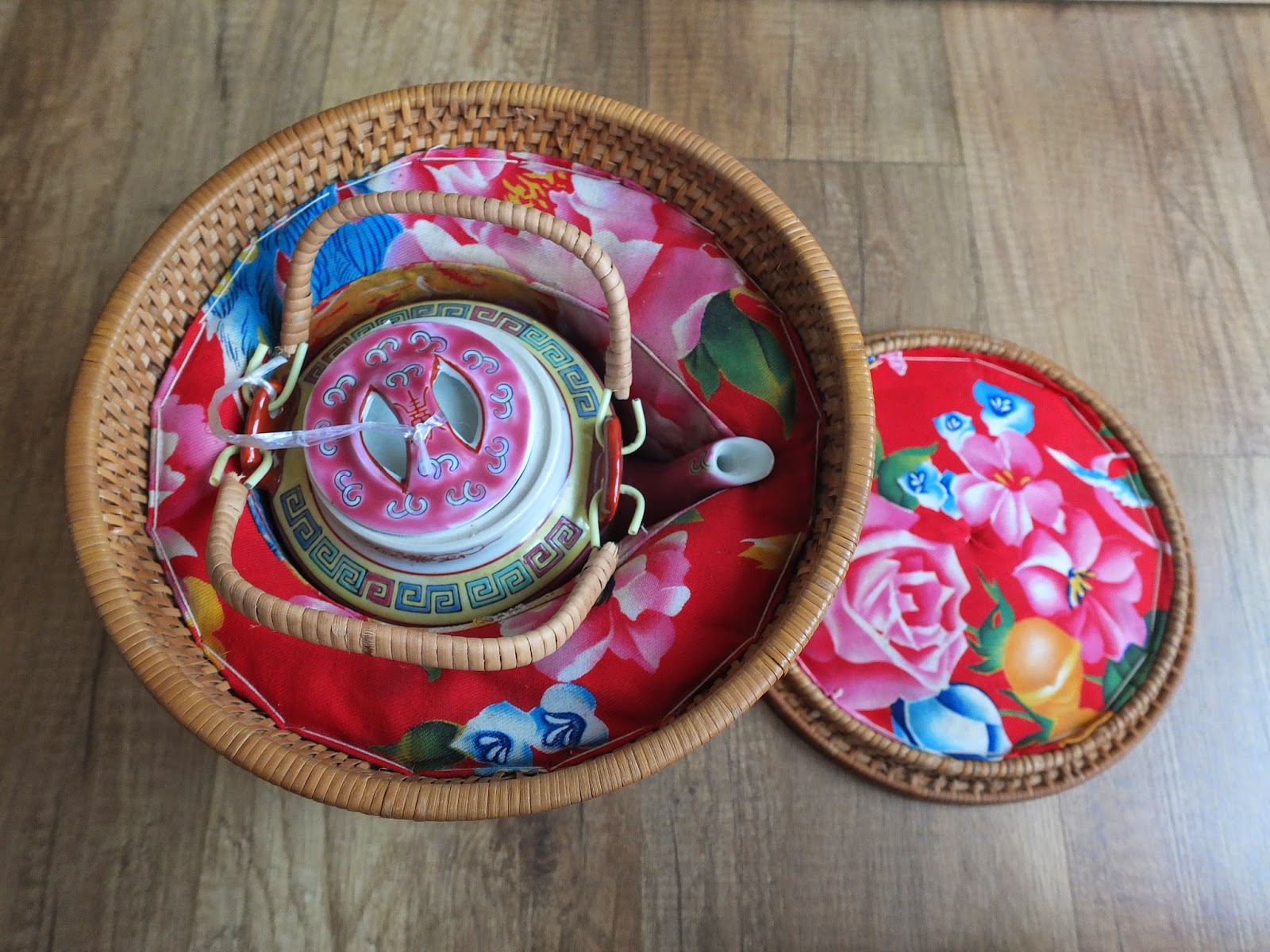
During the 1960s to 80s, one common sight in many homes and offices would be this basket that contain a cylindrical teapot. This tea set basically was designed to keep the tea warm for a few hours. If you noticed the 2nd pix, the interior of the basket is lined with thick foam but is 'wrapped' with a colorful cloth. Such a setup can enable up to 2 liters of tea to be kept warm. My teapot shown is smaller and holds about 1.5 liters instead. I was told that in the older days, a fresh brew was made every morning and another in the afternoon. A tray of teacups are usually located next to this tea basket. In some baskets, there are even space to store a couple of teacups.
I did ask my tea seniors if they remember how tea was brewed in such a set up. "Easy" - I was told. A few tablespoons of tea, and add hot water, and its ready to drink in a few minutes. What tea do they brew? I was told heavy roasted oolongs like TieGuanYin or Shui Hsien. Don't people drink coffee? Yes, mainly black sweetened coffee but its brewed and stored in vacuum flask instead of such a set up.
Brewing tea then was simple. I believe the term 'grandpa tea' is used to describe this brewing method. The tea leaves are perpetually soaked in the teapot and the tea will taste strong after such prolong soaking.
I bought some raw pu erh tea while I was browsing the Kunming tea markets a couple of months ago. This is the 2013 Xiaguan Fang Cha. This 100g square brick is very tightly compressed like their traditional iron cakes. You will observe the pointed spikes on the brick that was from the molding process when the tea was being compressed. One thing I learnt about Xiaguan compresed tea - put your palm on the brick, press your palm on the pointy side of the brick...its quite sharp.....if its blunt....may be a fake (I will verify this).
The description on the box says the tea used in producing this brick is made from 3 to 7 year old raw tea. Well, it was to me, the main selling point and I was sold by it. I had already noticed that new ripe pu erh being produced by major tea factories are already incorporating slightly old ripes into the new tea making drinking these tea very pleasant.
Back to this Xiaguan brick. Smoky - checked, some aged taste - checked. Aroma is very nice and I enjoyed the tea session. Given the choice of whether I prefer this tea or the new style 'green tea taste' pu erh.....I would rather settle for this inexpensive Xiaguan brick anytime.
I owned a couple of Lin Ceramic purion teapots. Purion clay, is a mixed of clay that has a high mineral content. In my opinion, this clay seemed to have a higher iron content which may explained the oxidization, or rust like color after regular use of this teapot. I intend to find out more about purion clay and will share my findings with my readers when I make a trip to Taiwan, hopefully next year.....that's where Lin Ceramic is located.
In my few years of drinking tea and learning more about tea by visiting Malaysia, Hong Kong, Taiwan and China, many tea shops allow you to sample their teas before you make a decision whether to buy their tea. One common observation would be that the sampling tea session would see the use of a porcelain gaiwan to brew the tea. The reason given, or is understood in the tea drinking community, is that use of clay teapots or clay teaware may affect (some say will enhance) the tea in terms of taste and aroma. In my opinion....Yes, there is a difference if a clay teapot is used, but....you need to be an old hand (or old nose) as the differences may be quite subtle. What are the reasons? It may be the clay, the way heat is maintained for a longer period or maybe the tea patina on the inside of a seasoned teapot does enhance the tea being brewed. There is no definite answer.
I was at Lau Yu Fat teashop Hong Kong a couple years ago when old man Lau asked me to purchased a Lin purion teapot. He had noticed that using this purion teapot had improved the taste of pu erh tea. I decided to get one teapot.
I got to examine this purion teapot at leisure when I was home. It looked rough as though it was an unfinished item. After using this teapot for more than 50 tea sessions, these were my findings. Old pu erh tea actually tasted better. It may be my imagination or it may be due to the iron content in the clay....but the tea taste seem slightly more pronounced. I felt purion teapots works very well with ripe pu erh tea.
I had the opportunity to visit Hong Kong this January and this time, Mr Lau used the purion teapot as a serving tea pitcher. He even used a porcelain tea pitcher at the same time to compare a tea being brewed. Somehow, the tea poured out from the purion teapot tasted better (to me).
The 2nd pix shows the 2 purion teapots I had purchased. The 2012 version (on the left), which I am using looked different from the unused 2013 version. Notice the color differences.
I believed there is another Lin purion teapot where there is a metal filter fixed inside the teapot. My recent purchase of a Lin Ceramic Duanni (yellow clay) teapot has such a metal filter. I personally do not like such metal filters inside a teapot. I shall blog about it soon.
If you drink a lot of pu erh tea, do consider getting a purion teapot. Some tea drinker friends tell me the tea has been tempered with the use of such teapots. Others feel that one should try to enhance the tea with such tea ware like teapots and even tea cups. Let me know your thoughts.
I only purchased 1 kg of ripe pu erh tea during my trip to Yunnan. This is it. 4 bricks of 2008 Fuhai ripe tea. I was told that this tea was made with similar materials from the 2007 Fuhai large leaf pu erh cake (link) which I had liked very much.
This brick was stored in Kunming and the climate there was less humid than Singapore. As a result, this Kunming storage brick tasted somewhat suppressed and lack the punch of ripe pu erh tea that I am used too. However, breaking up this brick, putting the tea in my tea caddy and only started brewing this tea after a couple of weeks did made drinking this tea a very pleasant experience. Yes, it did taste similar to the 2007 Fuhai cake which I liked. Nice woody aroma with a hint of floral notes. I must remember to get more of this tea in my next visit.
But I digressed. In my last blog, I mentioned the phenomenal prices of raw pu erh while I was in Yunnan. Yes, I had noticed that certain new pu erh tea was gaining popularity and the higher prices that accompanied these tea. Right now, raw pu erh teas from Lao Ban Zhang and Bing Dao are 'pu erh of the day'. Prices of these tea are pretty phenomenal, to me anyway. Prices of these tea are now commanding a few thousand RMB per kilo...which means a regular size cake made from these areas may cost close to US$200 retail.
Let me share my thoughts on why these tea cost so much. I believe there is a new group of tea drinkers/collectors that has came steadily into the Chinese Tea market. This group is made up of local Chinese, but they are financially affluent and enjoys 'conspicuous' consumption. They buy branded products and usually associate price with quality. When they drink or want to buy Chinese tea, they would usually demand the 'best' or the most expensive to demonstrate their purchasing power. As a result, Lao Ban Zhang and Bingdao pu erh teas have seen their prices rise because of this new demand. Yiwu pu erh is starting to jump up in prices as well. Tea dealers in China, who had taken advantage of this demand had benefitted as well. While I was in Kunming, I noticed many tea dealers now drive expensive European cars and had even able to open more shops and upgrade their standard of living. However, I would like to warn serious Chinese tea drinkers that you must know your tea if you want to buy these high end tea.....meaning....that its impossible that every tea shop has pure Banzhang or Bingdao tea - it could be a blend of teas inside your cake. Caveat Emptor. Buy your Chinese tea from a reputable teashop.